December 12, 2025

Switching to LED lighting can save up to 75% on energy costs, but upfront expenses can be a hurdle. Utility rebates in Texas help offset these costs, covering 25–50% (or more) of project expenses. However, navigating rebate programs is complex due to varying requirements, tight deadlines, and detailed paperwork. Here's what you need to know:
Navigating Texas's rebate programs can feel like a labyrinth, especially for turnkey lighting projects. The intricate rules and requirements tied to these incentives often lead to delays, reduced savings, and even forfeited rebates. Let’s break down some of the biggest hurdles that project managers face.
Texas utility providers don’t make it easy; their varying eligibility criteria can throw a wrench in project planning. Each rebate program has its own set of rules, often limiting which types of projects qualify. This patchwork of requirements complicates efforts to design lighting upgrades that align with multiple service territories.
For instance, many programs demand that lighting products meet specific energy efficiency standards, such as ENERGY STAR® certifications or DLC Standard/Premium listings. These requirements directly influence product selection. On top of that, some programs distinguish between residential and commercial properties, forcing businesses to verify that their projects align with commercial criteria.
Adding to the complexity, about 17% of rebate programs in 2025 will require contractors or distributors to be registered as "trade allies" - essentially pre-approved vendors. Without this registration, participation becomes impossible. Pre-approval processes and strict deadlines further complicate matters, leaving project managers juggling utility-specific requirements.
Missed deadlines or incomplete paperwork can derail a project’s rebate eligibility. Starting work without securing pre-approval? That’s a surefire way to disqualify a project. Delays can also mean businesses miss critical deadlines, forcing them to restart the entire application process under updated program rules.
Rebate applications demand meticulous planning and detailed documentation. As highlighted by the Litetronics Blog:
"The detailed planning and paperwork required for the customer rebate application can be extensive, often requiring a lot of time and effort to pull together. From there, the utility will have an engineer review your application to calculate what the rebate would be. Only when the project is approved can you order fixtures. This extended process can turn into a major problem if it's not taken into consideration when planning project timelines. So, make sure your application is flawless, to avoid any additional (and unwelcome) delays."
Product verification adds another layer of complexity. Many programs require LED fixtures to be DLC listed, and submitting products that don’t meet this standard can result in lost incentives. In some cases, businesses must track down the DLC number directly from the manufacturer, as relying on reseller assurances isn’t enough. And if that wasn’t enough pressure, rebate funds often run out before the year ends, making early planning essential.
Gathering the necessary paperwork and coordinating site inspections can feel like a full-time job. Businesses must compile invoices, product certifications, installation photos, and detailed lighting data within tight timeframes to ensure they qualify for rebates.
While online application portals aim to simplify the process, they’ve introduced new headaches. Frequent glitches can turn a quick submission into a 20-minute ordeal. Worse, utility staff - already stretched thin due to staffing cuts - are harder to reach than ever. General call centers often leave businesses waiting up to a week for responses, creating further delays. For internal teams without specialized expertise, managing these challenges can be overwhelming and time-consuming.
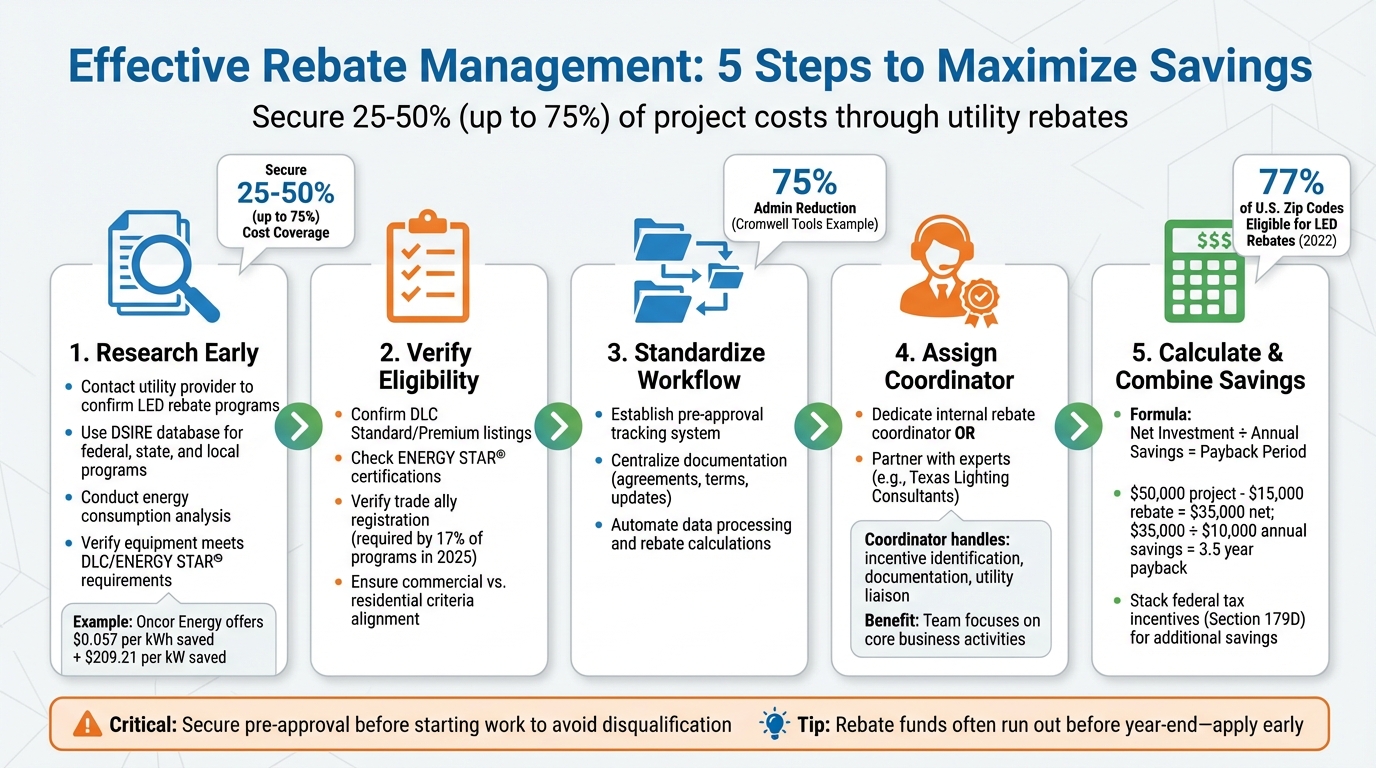
5-Step Rebate Management Process for LED Lighting Projects
Navigating Texas rebate programs doesn’t have to derail your lighting project. With thoughtful planning, you can secure utility incentives that cover 25–50% of project costs while avoiding delays and missed opportunities. Here’s how you can streamline your approach to researching, applying for, and managing rebates effectively.
One of the most common yet costly mistakes is waiting until after purchasing equipment to investigate rebate opportunities. Instead, make rebates part of your initial project planning. Start by contacting your utility provider to confirm available LED rebate programs and their requirements. For instance, Oncor Energy offers incentives like $0.057 per kWh saved plus $209.21 per kW saved for qualifying projects.
Since rebate structures vary by region, identifying your utility provider is key. Tools like the Database of State Incentives for Renewables & Efficiency® (DSIRE) can help you explore federal, state, local, and utility-level programs. Also, conducting a detailed energy consumption analysis early on can help you forecast payback periods and plan phased investments. This ensures you select equipment - like DLC-listed or ENERGY STAR® certified products - that meets rebate eligibility requirements from the outset.
The rebate process often involves a maze of documentation and deadlines, and fragmented approaches can lead to errors or missed opportunities. To avoid this, establish clear workflows for pre-approvals, deadline tracking, and submission processes. Centralizing rebate agreements, terms, progress updates, and performance metrics into a single platform can prevent version control issues that arise with scattered spreadsheets.
Automation can be a game-changer, simplifying data processing, rebate calculations, payment tracking, and claim settlements. For example, Cromwell Tools reduced its administrative workload by 75% after switching from spreadsheets to a centralized rebate management system. By staying organized and ensuring your equipment meets eligibility criteria, you can maximize the incentives available while avoiding the pitfalls of missed deadlines or incomplete submissions.
Managing rebates alongside your core operations can overwhelm your resources. To address this, assign a dedicated rebate coordinator or partner with experts like Texas Lighting Consultants. These professionals have in-depth knowledge of utility rebate programs, including local options like Austin Energy rebates, and can ensure your project meets all eligibility requirements.
A rebate coordinator takes charge of the entire process - identifying incentives, completing documentation, and liaising with rebate providers - allowing your team to focus on core business activities. With utility rebates potentially covering up to 75% of total project costs for lighting retrofits, expert management can make a huge difference. Given the complexity and time-intensive nature of rebate applications in Texas, having specialized support can simplify project management and eliminate the administrative burden on your team.
To figure out your net costs and payback periods, start by calculating the total project costs. This includes everything: LED fixtures, installation, disposal of old equipment, temporary lighting, and any management fees. Once you have that number, subtract all rebates and incentives to get your net investment.
The payback period is simple to calculate: just divide your net investment by your total annual savings. Annual savings should account for two key components: direct energy cost reductions and demand charge reductions (the lower charges for reduced peak power usage). Here's an example: if your total project cost is $50,000 and you receive $15,000 in utility rebates, your net investment becomes $35,000. If your annual energy savings amount to $10,000, your payback period is 3.5 years. You can further boost your savings by combining these rebates with federal tax incentives.
In 2022, about 77% of U.S. zip codes were eligible for commercial and industrial LED lighting and controls rebates. This makes these calculations applicable to a wide range of businesses. Tools like payback calculators can quickly estimate the ROI for an LED upgrade, factoring in both rebates and energy savings. Just make sure to include all costs upfront and use realistic energy-saving estimates.
After determining your net costs and payback period, you can lower expenses even further by stacking federal tax incentives on top of rebates. Federal programs, such as Section 179D, can be combined with state and utility rebates to significantly reduce your overall costs. For example, utility companies allocated $3.6 billion to energy efficiency incentives in 2016, with commercial customers receiving 49% of that total.
To make the most of these savings, apply utility rebates first to reduce upfront costs. Then, calculate federal tax deductions based on the qualifying improvements. Be careful not to double-count expenses, as this could lead to errors. For guidance, consider working with experts who can help navigate the requirements, such as those set by DLC standards.
Justin Stouch, President of Stouch Lighting, highlighted the value of expertise in November 2024:
"Incentive Rebate360's in-depth understanding of lighting technologies and available rebates has been instrumental in helping our clients realize faster paybacks on their upgrade projects."
Managing rebates effectively plays a key role in the financial success of a turnkey lighting project. By securing available incentives, you can lower upfront costs, speed up payback periods, and improve your overall return on investment (ROI). With rebates often covering anywhere from 30% to 75% of project costs, failing to take advantage of these opportunities can result in significant financial losses.
Preparation is critical. Start by setting up clear processes and always verify that rebate funds are available before moving forward. Many programs operate on limited budgets that reset annually, so timing is everything. A well-organized approach ensures smoother execution and access to expert guidance when needed.
Take, for example, the turnkey approach used by Texas Lighting Consultants. Their team simplifies the rebate process by handling everything from complex applications and site inspections to detailed paperwork. This ensures your project meets all program requirements while freeing you to focus on running your business.
To effectively manage utility rebate programs for lighting projects, begin by looking into the rebates offered by your local utility providers. Make sure the lighting products you intend to use meet the necessary qualification standards, such as DLC or Energy Star certifications.
Once you've confirmed eligibility, create an energy-efficient lighting plan that complies with the rebate program's requirements. Carefully prepare and submit all necessary documentation for the application, double-checking for accuracy and completeness. Coordinate the installation to ensure it aligns with program deadlines and confirm that the work is carried out as planned. Lastly, monitor the progress of your rebate claim to ensure you receive the full savings available. Following these steps can help simplify the process and maximize your benefits.
A rebate coordinator plays a key role in simplifying the rebate application process by staying well-organized and using their knowledge of rebate programs effectively. By maintaining thorough records, tracking deadlines carefully, and ensuring that all products meet necessary requirements - such as being DLC-listed - they can help avoid common mistakes and unnecessary delays.
On top of that, building strong relationships with utility trade allies and using digital platforms to handle applications can make the entire process much smoother. These approaches not only save valuable time but also increase the chances of successfully securing rebates.
Combining utility rebates with federal tax incentives is a powerful way to cut down the initial costs of lighting upgrades. These programs are specifically created to promote energy-efficient upgrades, making it more affordable to switch to modern lighting systems.
By taking advantage of both options, you can significantly boost your savings, reduce energy costs, and improve the efficiency of your lighting setup. This strategy not only aligns with sustainability efforts but also adds long-term value to your investment.

We’re a HUB-certified Texas lighting company specializing in surveys, calculations, and installations for government and contractor projects.
© 2025-26 | Texas Lighting Consultants | All Right Reserved.