December 17, 2025
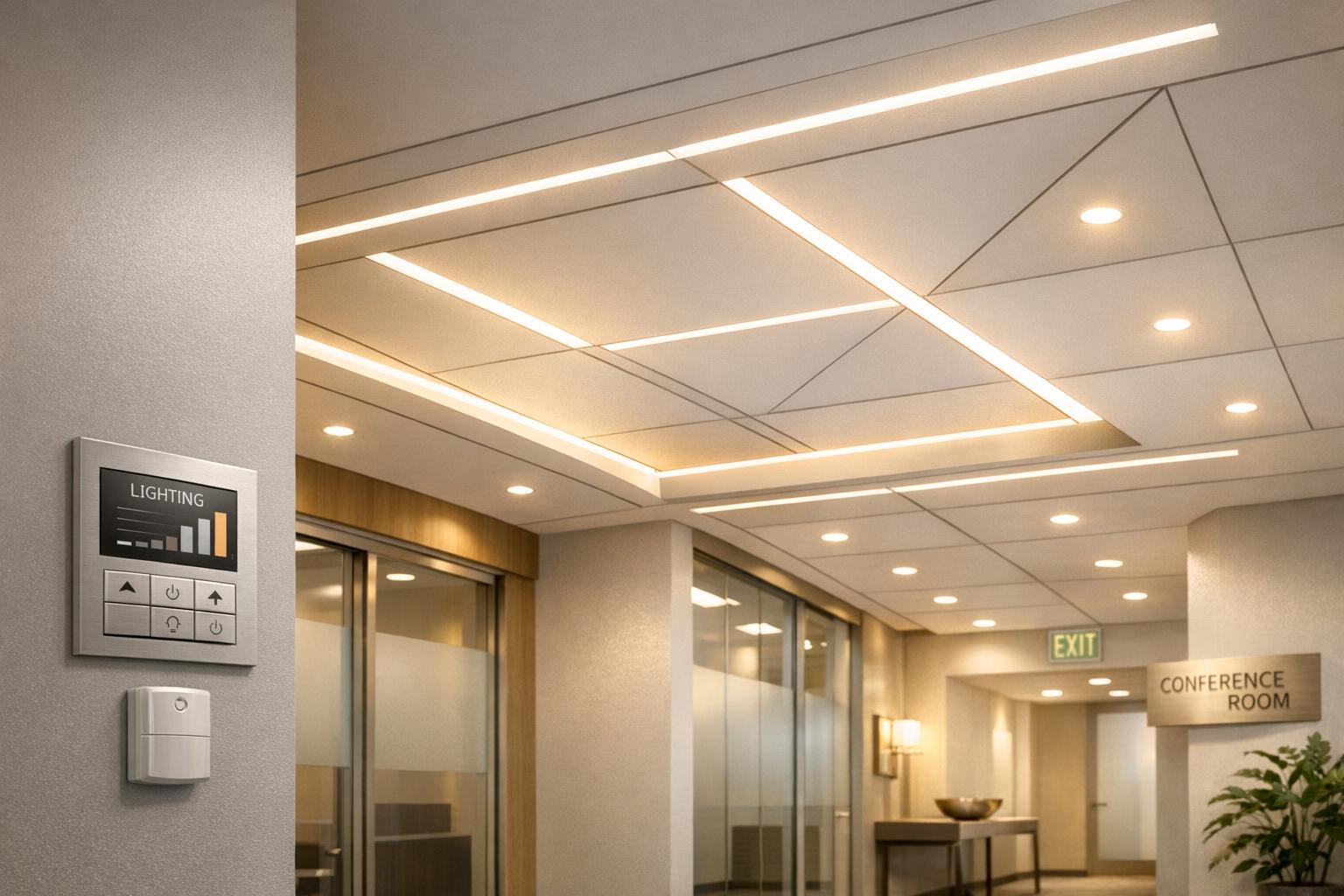
Navigating Texas lighting energy codes may seem tricky, but it's manageable when broken into simple steps. Here's what you need to know:
This step-by-step approach ensures energy-efficient lighting, cost savings, and adherence to Texas codes.

4-Step Process to Meet Texas Lighting Energy Codes Compliance
Before diving into lighting upgrades, it’s crucial to understand the energy code requirements in Texas. The state offers two compliance paths for commercial buildings: the International Energy Conservation Code (IECC) or the ANSI/ASHRAE/IESNA 90.1 standard. As of November 1, 2016, the statewide baseline for commercial construction references the 2015 IECC and ASHRAE 90.1-2013. However, local jurisdictions can adopt newer editions as long as they meet or exceed the state’s minimum standards.
The applicable energy code depends on your location and the type of building you’re working on. Major cities in Texas often update their standards independently. For instance:
State agency buildings and institutions of higher education must adhere to standards set by the State Energy Conservation Office (SECO), as outlined in Texas Government Code, §447.004.
When choosing between IECC and ASHRAE 90.1, remember this decision impacts every aspect of your project. The building envelope, mechanical systems, and lighting design must all comply with the selected standard. It’s a good idea to check with your local building department to ensure your project aligns with the applicable code.
These energy standards play a significant role in shaping your lighting design. Both IECC and ASHRAE 90.1 establish rules for Lighting Power Density (LPD) limits, fixture efficiency, and control systems. They set maximum wattage allowances per square foot based on the building type and space function, ensuring energy-efficient lighting installations.
Control requirements include features like:
For example, ASHRAE 90.1-2013 mandates photocontrols for general lighting in primary sidelighted areas with loads of 150 watts or more. Meanwhile, IECC 2015 requires all general lighting to shut off within 30 minutes of a space becoming unoccupied. These measures ensure compliance while promoting energy efficiency.
To align with Texas lighting energy codes, you'll need to focus on three main areas: calculating your Lighting Power Density (LPD), selecting efficient fixtures, and installing the right lighting controls. These steps will help you lower energy usage while keeping your space well-lit.
Lighting Power Density (LPD) is the amount of electrical power used for lighting per square foot, expressed as watts per square foot (W/ft²). To find your LPD, add up the wattage of all your lighting fixtures and divide that by the total square footage of the area. For instance, if your office uses 5,000 watts of lighting in a 2,500-ft² space, your LPD would be 2.0 W/ft². Compare this to the maximum limits for your building type as outlined in codes like the 2015 IECC or ASHRAE 90.1-2013.
You can calculate LPD using either the building area method, which applies a single LPD limit across the entire building, or the space-by-space method, which sets different limits for various room types. The method you choose will depend on your building's layout and usage, and it lays the groundwork for selecting compliant fixtures and controls.
High-efficiency fixtures deliver more light while using less power, measured in lumens per watt (lm/W). LEDs are a great choice, often achieving 80–120 lm/W, significantly outperforming older technologies like fluorescent lights. When picking fixtures, review the manufacturer’s specs for wattage and light output. Pay attention to features like color temperature and Color Rendering Index (CRI) to ensure the lighting suits the space, providing both comfort and productivity. These efficient fixtures not only meet code requirements but also cut down on energy costs over time.
To comply with 2015 IECC and ASHRAE 90.1-2013 standards, lighting controls are a must. Start with manual options like dimmer switches or multi-level systems, which let users adjust lighting based on their needs. These controls enhance energy efficiency and user comfort.
Automatic controls, such as occupancy sensors, are another essential component. They help save energy by dimming or turning off lights in empty spaces. Just make sure sensors are placed strategically to avoid issues like interference from direct sunlight. Together, these controls ensure compliance and improve overall energy performance.
After installation, it's crucial to document compliance to secure permits and pass inspections. This step builds on your design and installation work, ensuring everything aligns with the required standards. While the specifics may vary depending on your building type and location, the overall process follows a consistent structure. These steps help connect the dots between installation and official compliance verification.
A lighting energy audit ensures your installed system matches the design specifications. This includes verifying that your Lighting Power Density (LPD), fixture specifications, and control installations comply with code requirements. The audit results provide the necessary documentation to demonstrate compliance with the International Energy Conservation Code (IECC), the standard for commercial construction in Texas.
If your building is outside municipal jurisdiction, there are multiple ways to prove compliance. According to the Texas Health & Safety Code, Chapter 388, "a building with inspections from private code-certified inspectors using the energy efficiency chapter of the International Residential Code or International Energy Conservation Code shall be considered in compliance". Inspectors rely on your audit data to confirm adherence to the code. Alternatively, certification through programs like the U.S. Environmental Protection Agency's Energy Star Program can also serve as proof of compliance.
Once the audit is complete, compile detailed documentation to support your compliance. Start by creating a lighting schedule that lists fixture types, wattage, and locations, along with LPD calculations. Tools like COMcheck or REScheck can generate these compliance documents, and both are widely accepted for commercial and residential projects in Texas.
For state and state-funded buildings, you'll need to submit a completed compliance statement and certification to the relevant agency. For other buildings, compliance typically involves submitting plans through your local jurisdiction's permit process. Be aware that municipalities or counties may have additional amendments to state codes. It's a good idea to check with your local government office to understand any extra requirements for your project.
Rebate programs can help reduce the costs of upgrading to energy-efficient lighting by offering financial rewards for making these improvements.
Texas utility companies provide several rebate opportunities for lighting upgrades. For instance, Austin Energy offers commercial rebates that average around $5,000 for businesses, non-profits, and houses of worship that invest in energy efficiency upgrades. Additionally, small businesses and non-profits can receive a 30% bonus on top of standard commercial rebates. For new construction projects, their "New Construction Lighting" rebate offers up to $370 per kW saved when using high-efficiency lighting.
TXU SESCO Co. runs the TXU GreenBack energy efficiency program, which includes rebates for LED lighting upgrades as well as for installing lighting controls and sensors. This program supports communities like Buffalo, Jacksonville, Palestine, Mexia, and other areas within its service region. Meanwhile, Oncor provides a "Commercial Custom Option", designed for businesses in its territory. However, projects must secure at least $10,000 in incentives and receive pre-approval before beginning work.
To get started, reach out to your utility provider. For example, you can call Austin Energy at 512-482-5346 or visit the TXU business rewards website. Begin the process early, especially for new construction projects, to make the most of the rebates available. For a smoother experience, consider seeking professional guidance.

Applying for rebates and staying compliant with regulations can be a complex process. Texas Lighting Consultants is here to simplify it. They offer services like lighting assessments, energy-efficient design, rebate application assistance, and compliance documentation. As a HUB-certified, woman-owned business, they specialize in turnkey LED retrofits for commercial, educational, and municipal facilities across Texas. Their team manages everything from project planning to installation support, including handling all the necessary paperwork to secure your rebates and incentives.
Navigating Texas lighting energy codes can be manageable if you break it down into clear steps. Begin by identifying the relevant energy standards and reviewing any local amendments. From there, calculate your lighting power density, choose high-efficiency fixtures, and install the required lighting controls. Be sure to document everything thoroughly to secure your Certificate of Occupancy.
The rewards for compliance go beyond just meeting regulations. Projects often see financial paybacks in as little as 0.6 years, along with notable reductions in life-cycle costs. Beyond the financial aspect, compliance leads to lower utility bills, better lighting quality, enhanced occupant comfort, increased property value, and a positive impact on the environment by cutting greenhouse gas emissions and easing grid demand.
For a smooth journey from initial assessment to final documentation, working with professionals can help you maximize these benefits while ensuring full compliance.
Texas adheres to two primary commercial energy codes: the 2015 International Energy Conservation Code (IECC) and ASHRAE 90.1-2013, each offering a distinct compliance path.
The IECC takes a prescriptive approach, setting specific limits like lighting power density (LPD) and incorporating allowances for daylight controls. For those seeking flexibility, it also includes a performance-based option, such as the Energy Rating Index.
On the other hand, ASHRAE 90.1 goes deeper into lighting control requirements. It outlines detailed rules for features like dimming, occupancy sensors, and automatic shut-off systems that activate after 30 minutes of vacancy. While the core requirements for lighting controls are the same in both standards, the primary difference lies in how compliance is achieved. The IECC leans on prescriptive LPD tables, whereas ASHRAE 90.1 focuses on more granular control specifications, allowing designers to select the standard that best suits their project goals.
To calculate Lighting Power Density (LPD) for your commercial building and ensure it aligns with Texas energy codes, here’s how you can proceed:
If you need expert assistance, Texas Lighting Consultants can help verify calculations, choose compliant fixtures, and implement energy-saving solutions designed for your project.
Texas has plenty of rebates and incentives to help property owners save money when upgrading to energy-efficient lighting. Major utility providers like Austin Energy, Oncor, and TXU have programs designed to offer financial perks for installing LED fixtures, lighting controls, and other energy-saving solutions.
Take Austin Energy, for example. They provide rebates that average around $2,600 per project for energy-efficient lighting installations. Oncor also steps in with incentives for both standard and custom commercial lighting upgrades. Meanwhile, TXU’s GreenBack program reimburses businesses for LED retrofits based on how much energy the project is expected to save.
These programs not only help reduce the upfront costs of lighting upgrades but also make it easier to comply with Texas energy codes, all while cutting energy bills and boosting lighting performance.

We’re a HUB-certified Texas lighting company specializing in surveys, calculations, and installations for government and contractor projects.
© 2025-26 | Texas Lighting Consultants | All Right Reserved.