August 5, 2026

If your Texas school wants LED funding in 2026, start with the utility territory. That one step tells you which rebates, grants, and loan programs may apply before you buy fixtures or start work.
I’d boil this guide down to a few points:
If I were screening options fast, I’d group them like this:
The big takeaway is simple: match the campus meter to the right program, check the rules before purchase, and keep fixture, cost, and savings records from day one.
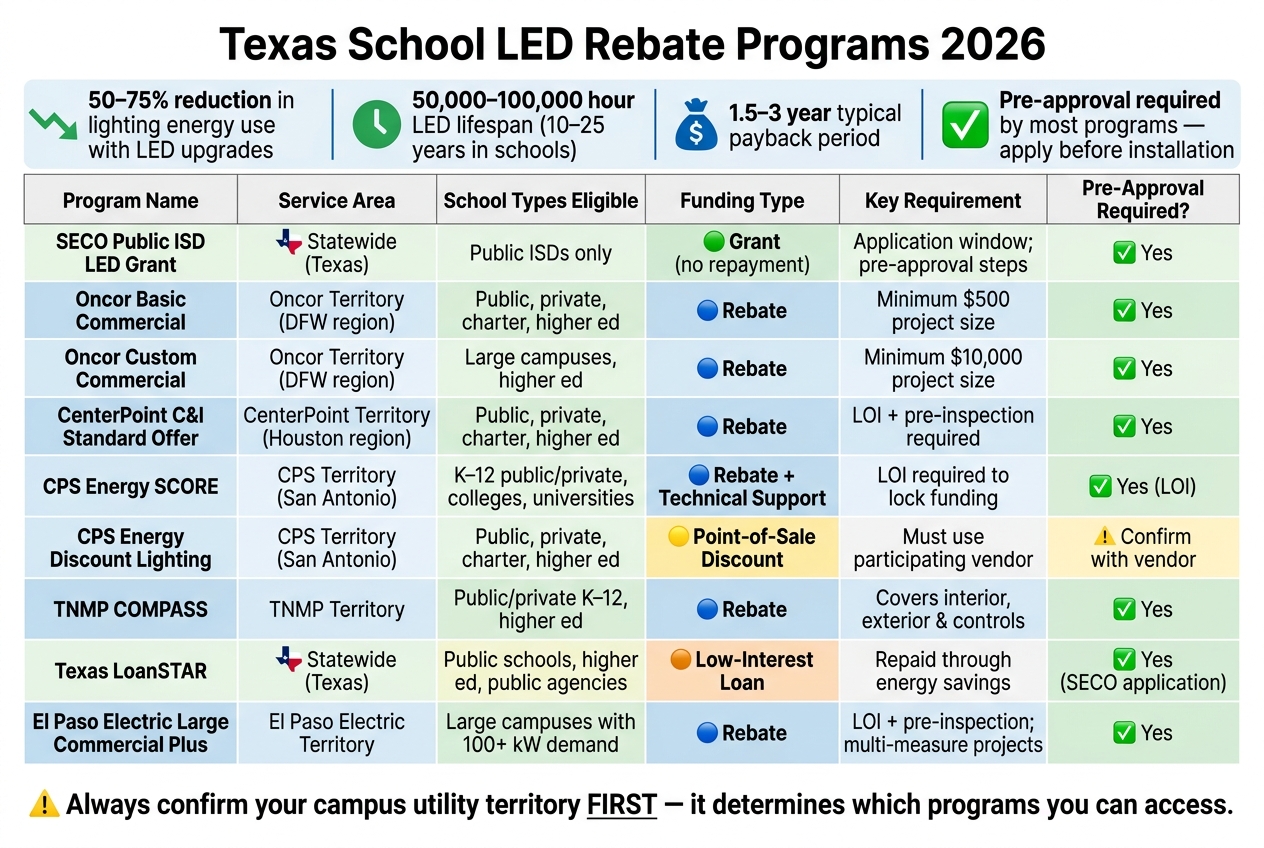
Texas School LED Rebate Programs 2026: Side-by-Side Comparison
| Program | Where it applies | School types | Funding type | Main note |
|---|---|---|---|---|
| SECO Public ISD LED Grant | Statewide | Public ISDs | Grant | Check application window and approval steps |
| Oncor Basic Commercial | Oncor territory | Public, private, charter, higher ed | Rebate | Starts at $500 minimum project size |
| Oncor Custom Commercial | Oncor territory | Large campuses, higher ed | Rebate | Starts at $10,000 minimum project size |
| CenterPoint C&I SOP | CenterPoint territory | Public, private, charter, higher ed | Rebate | LOI and pre-inspection usually apply |
| CPS Energy SCORE | CPS territory | K–12, private, colleges, universities | Rebate | Built for school projects |
| CPS Discount Lighting | CPS territory | Public, private, charter, higher ed | Point-of-sale discount | Discount is applied at purchase |
| TNMP COMPASS | TNMP territory | Public/private K–12, higher ed | Rebate | Covers interior, exterior, and controls |
| Texas LoanSTAR | Statewide | Public schools, higher ed, public agencies | Low-interest loan | Good for funding gaps |
| El Paso Electric Large Commercial Plus | El Paso Electric territory | Large campuses with 100+ kW demand | Rebate | Often fits larger multi-measure jobs |
Bottom line: I’d use this article as a short map - find the service area first, then compare whether the campus needs a rebate, a grant, or a loan.
Once you've confirmed the utility territory, the next step is simple: why move in 2026 instead of later?
For many Texas schools, the answer comes down to cost. A lot of campuses still use fluorescent troffers, metal halide gym fixtures, and older HID exterior lights. Those systems burn more power than LEDs and often need lamp and ballast replacements. Over time, that means higher electric bills and more money spent on upkeep.
That's also why many incentive programs center on these common retrofit jobs.
Older lighting systems don't just use more electricity. They also create a steady stream of maintenance work. When lamps fail or ballasts go out, staff time and budget get pulled into repairs that could often be avoided with an LED upgrade.
For schools trying to stretch every dollar, that adds up fast.
Most Texas utility programs tend to support the same main lighting upgrades:
Interior and exterior retrofits usually qualify, and some new construction projects may qualify too.
That said, approval still depends on the utility that serves the campus.
Your utility territory decides which incentive programs your school can use. That part matters more than many people expect.
A Dallas–Fort Worth school served by Oncor may qualify for Basic Commercial or Custom Commercial incentives, with projects starting at $500 for basic upgrades and $10,000 for custom projects. An El Paso Electric school may qualify for Large Commercial Plus if campus demand is at least 100 kW.
Before moving ahead, confirm the utility tied to the campus meter. Some programs also ask for the Electric Service Identifier (ESIID) from the utility bill before they approve a project.
Once you know the service area, matching the campus to the right program gets much easier.
SECO offers a statewide grant for Texas public ISDs, no matter which utility serves the district. That sets it apart from utility-linked rebate programs. The grant covers interior and exterior LED retrofits.
Before you apply, get the basics in order:
It’s smart to check SECO’s current guidance before installation. A small miss upfront can slow the process later.
If your district falls outside SECO’s scope, a utility-specific program may be the next best option.

For schools in Oncor territory, this is the main utility-backed incentive path.
The program is for K–12 public schools, universities, and other public schools and universities served by Oncor. Rebates are performance-based, which means the payout depends on verified energy savings and peak demand reduction measured in kW.
There’s one rule you can’t gloss over: pre-approval is required. Work can't start until Oncor gives formal approval. Applications are submitted through Oncor's EEPM (Energy Efficiency Program Management) portal, where you'll need to provide facility data, utility account details, and a clear project scope.
After the new equipment is installed, Oncor checks the results before sending the rebate. So this isn't a “submit and hope for the best” setup. The paperwork and timing matter.
A good example is Dallas ISD. The district has earned more than $800,000 in total rebate incentives through this program, helping pay for lighting retrofits across elementary, middle, and high school campuses.
Before you schedule any work, confirm that the site is eligible in the EEPM portal. If you want help with the paperwork, a turnkey partner like Texas Lighting Consultants can manage the documentation and compliance.
If your school isn't in Oncor territory, move to the next utility-specific program.
For campuses in CenterPoint territory, the process looks a lot like Oncor’s, but the rules and approval steps are specific to CenterPoint.
CenterPoint’s Commercial & Industrial Standard Offer Program covers schools, universities, and other nonprofit education facilities in its territory. Before you apply, check CenterPoint’s current peak-demand eligibility requirements. Incentives are performance-based and tied to verified demand reduction and energy savings.
You’ll need to enroll before installation, submit the LOI, and complete the pre-inspection so CenterPoint can verify the baseline lighting system. Texas Lighting Consultants can handle the LOI and pre-inspection steps for your campus.
Next, CPS Energy offers another school-relevant path for campuses in San Antonio territory.
For schools in the San Antonio area, CPS Energy's SCORE program is the local incentive route built for education projects. SCORE stands for Schools Conserving Resources, and the program gives both incentives and technical support to schools in the CPS Energy service area. Eligible sites include K-12 public schools, private schools, colleges, and universities in CPS Energy territory.
Most schools begin by reaching out to a Program Consultant and sending in a Letter of Intent (LOI) to lock in funding. Before the project moves forward, check CPS Energy's current rules for applications, required documents, and install timing.
If your school wants more hands-on project help, Texas Lighting Consultants can assist with planning and delivery. The next CPS Energy program is a more straightforward path for standard lighting rebates.
For schools in CPS Energy territory, the Discount Lighting Program gives you a point-of-sale discount on qualifying LED products. That means the discount is applied when you buy the products, not paid back after installation.
For a standard LED retrofit, that can make the upfront budget easier to handle. It also means timing matters. So does working with a participating vendor.
Before you buy anything, confirm CPS Energy’s current rules for ordering, pre-approval, and distributor participation. Program terms can change, and eligibility may depend on the product type and whether the vendor is part of the program.
If you want help with the admin side, Texas Lighting Consultants can handle rebate paperwork and compliance for turnkey LED upgrades.
Next, compare this option with TNMP's school lighting incentives.

If your school is in TNMP territory, the next utility program to look at is COMPASS. TNMP COMPASS is TNMP’s energy-efficiency incentive program for public and private K–12 schools, as well as higher-ed campuses served by TNMP.
Schools in the program may qualify for incentives for:
Like other utility programs, pre-approval and timing can make or break eligibility. That means you should check TNMP’s current rules before you buy equipment or lock in an install date.
Review TNMP’s latest pre-approval, paperwork, and deadline requirements before ordering materials or scheduling installation.
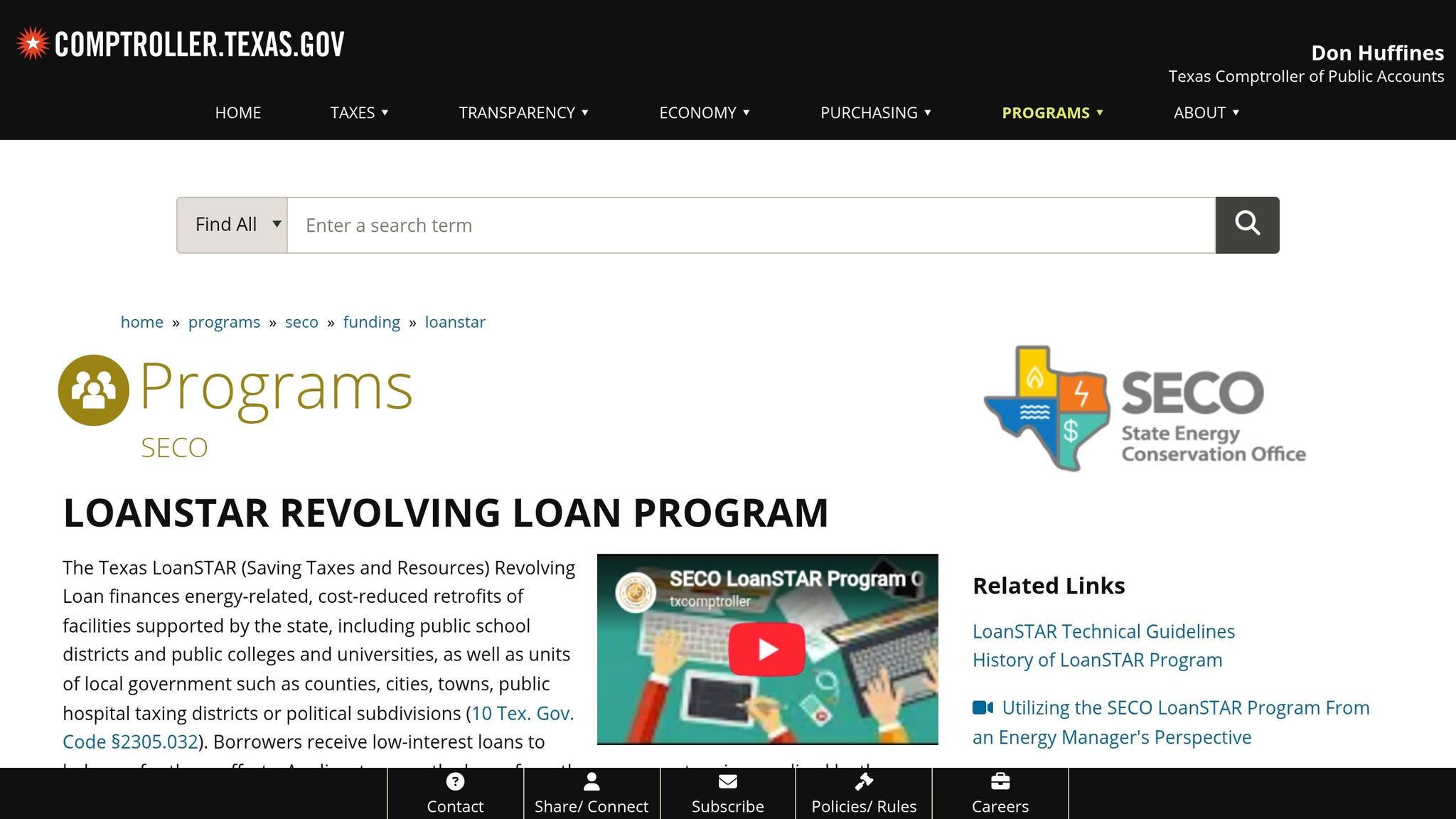
Texas LoanSTAR helps cover funding gaps for larger LED retrofit projects. Short for Loans to Save Taxes and Resources, LoanSTAR is a revolving loan program administered by SECO that offers low-interest financing for LED upgrades. If your district needs more money beyond rebates, this program can help bridge that gap.
LoanSTAR is available statewide, so eligibility does not depend on utility territory. The program serves public school districts, public institutions of higher education, state agencies, local governments, and tax-supported public hospitals across Texas.
The loan is repaid through the lighting savings the project generates. That makes it a solid fit for districts that want to move ahead without waiting for the next budget cycle or a bond approval.
You should expect a SECO application and approval process, so it’s smart to review the current rules before you apply. If your campus still needs more capital after that, the next section looks at federal and supplemental funding options.
Some campuses need more than a standard rebate can cover. In those cases, supplemental programs can help pay for larger retrofit packages. And for Texas schools, that can make a big difference on bigger LED projects.
One option is El Paso Electric's Large Commercial Plus program, which covers lighting retrofits, lighting controls, HVAC upgrades, and building envelope measures. That broader range makes it a good fit for campuses planning multi-measure projects, not just a basic lighting swap.
These programs still depend on careful planning and clear savings records. Most begin with an LOI, then move to a pre-inspection before any work starts and a post-inspection after installation. On larger jobs, schools may also need measurement and verification (M&V) data to show the savings and qualify for higher-tier incentives.
The main difference comes down to eligibility and scope. Utility rebates are tied to a service territory, while supplemental programs can support a broader mix of project types.
After looking at each program on its own, this chart helps you line up your campus with the funding path that fits faster.
| Program Name | Service Area | Eligible School Type | Funding Type | Incentive Basis | Pre-Approval |
|---|---|---|---|---|---|
| SECO Public ISD LED Lighting Grant | Statewide | Public ISDs | Grant | Direct funds; no repayment | Yes |
| Oncor Basic Commercial | Oncor territory | Public, private, charter, higher ed | Rebate | Per qualified efficiency measure; minimum $500 | Yes |
| Oncor Custom Commercial | Oncor territory | Large campuses, higher ed | Rebate | Verified savings; minimum $10,000 | Yes |
| CenterPoint C&I Standard Offer | CenterPoint territory | Public, private, charter, higher ed | Rebate | Verified demand reduction and energy savings | Yes |
| CPS Energy SCORE | CPS Energy territory | K–12 public, private, higher ed | Rebate + technical support | Energy savings | Yes (LOI required) |
| CPS Energy Discount Lighting | CPS Energy territory | Public, private, charter, higher ed | Point-of-sale discount | Applied at purchase | Confirm with vendor |
| TNMP COMPASS | TNMP territory | Public, private K–12, higher ed | Rebate | Energy savings; interior, exterior, controls | Yes |
| Texas LoanSTAR | Statewide | Public schools, higher ed, state and local agencies | Low-interest loan | Repaid through energy savings | Yes (SECO application) |
| El Paso Electric Large Commercial Plus | El Paso Electric territory | Large campuses, higher ed with 100+ kW demand | Rebate | Peak kW reduction | Yes (LOI and pre-inspection) |
Start with your service area first. Then sort your options into utility rebates, grants, and financing.
If your campus sits inside a given utility territory, find the matching row and check the pre-approval step before you order equipment. That part matters more than many teams expect.
If your campus doesn't line up with a utility rebate program, or if the rebate won't cover enough of the project, the statewide options can still help. SECO's grant and Texas LoanSTAR financing stay on the table no matter which utility serves your meter.
Dallas ISD shows what a large Oncor-area district can do with a bundled retrofit plan.

Dallas ISD has used Oncor's Educational Facilities Partners Program for lighting retrofits and other efficiency work. Under the Campus-Based Incentive Program, campuses receive 20% of monthly energy savings.
Dallas ISD says the program has cut energy costs and helped ease budget pressure.
Results like this usually come down to a few simple things: getting approval early, putting clear savings estimates on paper, and keeping complete project records. From there, the next move is simple - get the paperwork in order before any work begins.
Use this checklist to help avoid delays in any Texas school LED rebate application. The steps below apply across the programs in this guide.
First, verify which utility serves the meter. Then match each campus to that program’s rules before you scope the project. That small step can save a lot of back-and-forth later.
Utilities want exact fixture and operating data. That means you should submit a fixture-by-fixture inventory, actual operating hours, and projected energy and peak-demand savings.
For custom programs, measured and verified (M&V) documentation is often required. Good records make it easier to support higher incentive tiers and help prevent delays.
Timing matters here. If you start installation before approval, you can lose eligibility.
Submit the LOI, complete the pre-inspection, and wait until approval is in hand before you order or install anything. It’s one of those rules that sounds strict because it is.
After installation, a post-installation inspection is required to confirm that qualifying equipment was installed. Keep every invoice, product specification sheet, model number, and installation record in one place and easy to pull up.
For custom projects, that same paperwork supports the M&V process used to determine the final incentive amount.
If the project covers multiple buildings, outside help can make the process a lot easier. Texas Lighting Consultants can handle fixture counts, rebate paperwork, and post-inspection documentation.
The next section shows how this prep work plays out in actual school projects.
The best LED rebate for a Texas school comes down to four things: utility territory, campus type, project size, and funding setup.
Start with the campus meter and match it to the right utility. That step shapes program eligibility, minimum project size, and the kind of incentive you can get. Project size matters too. A small classroom retrofit may fit one program path, while a district-wide, multi-building upgrade may fit another.
Once you’ve pinned down those two pieces, go straight to the current program rules and paperwork.
Before you order fixtures, check the current 2026 rules, approved measures, and funding status. Submit the LOI early so you can help reserve funding and make sure all lighting measures qualify before installation.
For multi-building or mixed-scope projects, Texas Lighting Consultants can handle the documentation and compliance.
Check your electric bill first. Your ESIID (Electric Service Identifier) number is usually listed there. It’s often used to confirm your facility’s service location and whether the site qualifies for a given program.
If you don’t have a bill, contact local municipal offices or use online lookup tools from state utility regulators to identify the utility that serves your address.
Yes. Schools can often combine funding sources to cut the cost of LED lighting upgrades. For example, they may pair utility rebates with PACE financing to boost total savings.
Some entities may also qualify for more than one program across different utility service areas. The key is making sure your project meets each program’s eligibility rules. Texas Lighting Consultants can help you sort through those requirements.
Before you apply, pull together the paperwork first. That usually means:
Many programs also ask for pre-installation photos, a W-9 form, and, for new construction, a lighting COMCheck report.
Always get written pre-approval before starting work.

We’re a HUB-certified Texas lighting company specializing in surveys, calculations, and installations for government and contractor projects.
© 2025-26 | Texas Lighting Consultants | All Right Reserved.