December 14, 2025
Managing energy costs in large facilities can be challenging, especially in deregulated markets like Texas. However, by focusing on energy optimization, facilities can reduce expenses, improve system reliability, and lower electricity usage by 20–40%. Here's what you need to know:
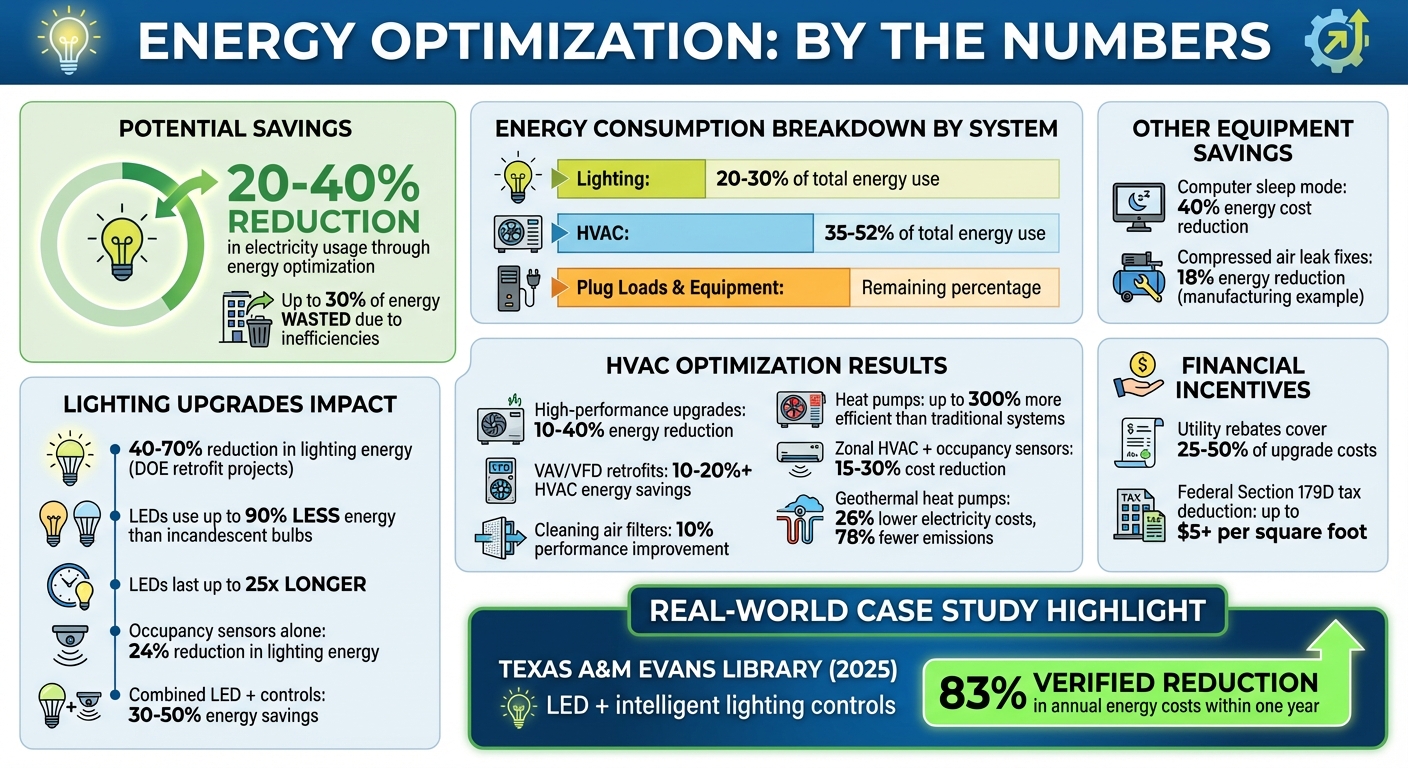
Energy Optimization Impact Statistics for Large Facilities
Building an effective energy optimization plan begins with understanding your facility’s current energy usage. Start by gathering utility data from the past 12–24 months and conducting energy audits. This helps establish a baseline, pinpoint inefficiencies, and track progress over time. From there, set specific and measurable goals, like cutting overall energy consumption or reducing energy use intensity (EUI) within a set timeframe.
An energy management framework helps monitor, analyze, and act on energy data. Tools like the ENERGY STAR Portfolio Manager can benchmark your facility’s performance against similar buildings. Key metrics to track include kWh per square foot, cost per kWh, and demand charges. Since inefficiencies can waste up to 30% of energy, identifying these early is essential. The process begins with measuring energy use to uncover the primary sources of consumption. A strong energy management plan should include clear goals, highlight areas for improvement, prioritize projects, and establish systems for regular monitoring and adjustments.
Energy optimization requires collaboration across roles. Facility managers handle daily operations and equipment performance, while energy managers or sustainability coordinators focus on analyzing data, planning projects, and tracking progress. Executive leadership plays a key role in approving budgets and aligning energy initiatives with broader organizational goals. Clearly defined roles ensure accountability and help embed energy optimization into the facility’s culture. Once responsibilities are set, the next step is to determine which projects will have the most immediate impact.
When deciding where to start, focus on improvements that balance cost, ROI, and the facility’s specific needs. Lighting and HVAC systems are often great starting points since they account for a significant share of energy use. For example, lighting alone typically represents 15–20% of electricity consumption. A case in point: In 2025, Texas A&M University's Evans Library implemented an energy savings program that included LED lighting upgrades and Autani intelligent lighting controls. This resulted in an impressive 83% verified reduction in annual energy costs within just one year. Additionally, many utility rebate programs can cover 25–50% of upgrade costs if projects meet their criteria.
When prioritizing upgrades, look for solutions that not only reduce energy use but also lower maintenance demands, improve safety, enhance occupant comfort, and increase productivity.
"A thorough, data-driven assessment doesn't just diagnose today's pain points; it helps uncover low-cost, high-ROI opportunities that build momentum for bigger wins across your energy strategy." – Mantis Innovation
Once you've outlined your energy plan and set your priorities, the next step is to focus on the systems that consume the most energy. Typically, lighting, HVAC, and plug loads are the primary drivers of energy costs in large facilities. By addressing these areas with a strategic approach, you can achieve noticeable energy savings while laying the groundwork for long-term efficiency.
Lighting represents 20–30% of total energy use in commercial buildings, making it a key area for improvement. Transitioning to LED fixtures can dramatically lower energy consumption. In fact, DOE retrofit projects have reported 40–70% reductions in lighting energy depending on the implementation. LEDs not only use up to 90% less energy than traditional incandescent bulbs but also last up to 25 times longer.
To maximize these savings, pairing LEDs with smart controls is essential. Occupancy sensors, daylight harvesting, and networked control systems automatically adjust lighting based on actual needs. A Lawrence Berkeley National Laboratory study found that occupancy sensors alone can cut lighting energy use by 24% in commercial spaces. Combining these controls with LED upgrades can push energy savings into the 30–50% range, depending on the specific strategies used.
For even greater efficiency, integrating lighting systems with Building Automation Systems (BAS) or Building Energy Management Systems (BEMS) is a game-changer. These platforms allow centralized control, real-time monitoring, and peak load management to reduce demand charges. In Texas, Texas Lighting Consultants offers services like comprehensive lighting assessments, LED retrofits, and control system integration for commercial, educational, and municipal buildings. They also assist with rebate documentation to help offset project costs.
HVAC systems are the largest energy consumers in most facilities, accounting for 35–52% of total energy use in U.S. commercial buildings. Because of their high energy demand, optimizing these systems can yield significant savings. High-performance HVAC upgrades can reduce energy use by 10–40%, while retrofits like Variable Air Volume (VAV) and Variable Frequency Drives (VFDs) can cut HVAC energy consumption by 10–20% or more.
Regular maintenance is a simple yet effective way to boost efficiency. For example, cleaning air filters alone can improve HVAC performance by 10%. Beyond maintenance, upgrading to high-efficiency equipment like chillers, boilers, or heat pumps can make a big difference. Heat pumps, for instance, can be up to 300% more efficient than traditional HVAC systems. Facilities in the Southern U.S. that use geothermal heat pumps have reported 26% lower electricity costs and 78% fewer emissions compared to gas boilers.
Control optimization is another critical step. Zonal HVAC systems paired with occupancy sensors can reduce HVAC costs by 15–30%. Additional measures, such as adjusting temperature settings, scheduling operation based on occupancy, and using demand-controlled ventilation, further cut energy use while maintaining comfort. Regular commissioning and recommissioning - ensuring systems are operating as designed - can also deliver quick returns, as settings often drift over time.
After addressing the major systems, it’s important to focus on plug loads and specialized equipment, which are often overlooked but contribute significantly to energy use. Office equipment, data centers, and specialized machinery can all be optimized. For example, enabling sleep mode on computers, monitors, and copiers can slash energy costs by 40%. Smart power strips can automate this process by shutting off peripherals when the main device is powered down.
Specialized equipment offers additional opportunities for savings. At one manufacturing site, a study by Sustainable Solutions Corporation revealed that compressed air systems accounted for 25% of total electricity use. By fixing leaks - often as simple as tightening fittings - the site reduced energy consumption by 18%.
Submetering is a valuable tool for identifying inefficiencies. At the Acuity Brands Lighting Midwest Distribution Center in Des Plaines, IL, sensors attached to forklifts provided data through the Atrius Energy dashboard. The analysis showed that only 75% of the forklift fleet was in use, allowing the facility to downsize its fleet and uncover further savings. Similarly, using Variable Frequency Drives (VFDs) for motor-driven systems can adjust speed to match demand, cutting down on unnecessary energy use.
Making smart energy decisions starts with having clear metrics and solid financial analysis. Without a clear picture of where energy is being used, facilities risk pouring money into upgrades that don’t deliver the expected returns. By pairing real-time monitoring with detailed financial evaluations, you can focus on projects that truly make a difference to your bottom line. Accurate data helps financial assessments zero in on the most cost-effective energy investments.
A key part of effective energy management is collecting granular data. Submetering divides energy usage by specific systems, equipment, or zones within a building, rather than relying on a single utility meter for the entire facility. This approach highlights exactly where energy is being consumed - and wasted.
Real-time tracking takes this a step further by monitoring energy use as it happens. This allows facility managers to spot patterns and anomalies immediately, enabling quick corrective action. This visibility helps optimize energy distribution, avoid peak demand charges, and confirm that energy-saving strategies are working effectively.
The potential savings are impressive. For example, a study published in Energy (September 2025) showed that applying a machine learning-based optimization framework to utility systems in large-scale manufacturing reduced energy consumption by 2–11%, improving economic efficiency by 6% to 10%. Similarly, another manufacturing facility cut energy costs by 15% through better efficiency and load management.
Once you’ve identified areas for improvement, the next step is to decide which projects are worth pursuing. Tools like life-cycle cost analysis, net present value, and simple payback period calculations can help determine whether a project is financially viable.
These methods provide a clear picture of the numbers. While some upgrades might involve a higher upfront cost, the energy savings over time can more than justify the investment, often recouping expenses within a reasonable period. Running these calculations helps prioritize projects that align with both your budget and energy goals.
Of course, the initial cost of implementing data analytics solutions - such as software, hardware, and skilled personnel - needs to be factored in. But the ability to monitor and analyze energy performance continuously ensures that savings are sustained over time. Advanced fault detection and diagnostics (FDD) tools add another layer of efficiency by tracking system performance and catching issues before they escalate into costly problems.
Financial analysis gets even better when paired with Texas utility incentives, which can significantly improve project returns. For example, federal tax deductions under Section 179D offer up to $5+ per square foot for building owners investing in energy-efficient upgrades. Architects, engineers, and designers working on government-owned properties can claim up to $1.80 per square foot. The Renewable Electricity Production Tax Credit (PTC) provides tax benefits for renewable energy generation, and Texas also offers a Renewable Energy Systems Property Tax Exemption for installations like solar panels or wind turbines.
Utility-specific programs vary but offer valuable opportunities. CPS Energy’s Commercial Solutions Program in San Antonio provides rebates for lighting, HVAC, refrigeration, and other projects. CenterPoint Energy’s Commercial Market Transformation Program (C-MTP) supports schools, municipal governments, healthcare facilities, and more, even covering ENERGY STAR certified LED lighting. In Austin, the Commercial New Construction Efficiency Rebates program encourages high-efficiency systems in new buildings, while the Multi-Family Energy Efficiency Rebate Program supports upgrades like insulation, windows, and HVAC systems.
Texas Lighting Consultants can assist with rebate documentation, ensuring you capture all available incentives. When combined with energy savings, these programs often lead to payback periods short enough to make projects financially appealing right away.
Energy optimization is more than just cutting back on energy use - it ties directly into achieving larger organizational objectives. By using less energy, facilities can reduce greenhouse gas emissions, strengthen their operational resilience, and free up funds that can be redirected toward other projects. This creates a cycle where savings fuel further improvements, paving the way for long-term environmental and financial progress. These broader outcomes go hand in hand with the cost-saving and efficiency strategies discussed earlier.
Every kilowatt-hour conserved translates into fewer carbon emissions, making it easier for facilities to hit net-zero targets while showcasing their commitment to corporate social responsibility. By cutting down on electricity generated from fossil fuels, organizations can shrink their environmental footprint. This not only benefits the planet but also enhances their image with eco-conscious customers, employees, and stakeholders.
To ensure these reductions are lasting, a structured and phased improvement plan is essential.
Taking a phased approach makes energy optimization both achievable and cost-effective. Start with low-cost, high-impact changes like upgrading to LED lighting, fine-tuning control systems, or making simple operational adjustments. These initial steps deliver quick results and generate immediate savings. With those savings, facilities can move on to mid-term projects such as upgrading HVAC systems or improving building insulation. Over time, as technology advances and savings grow, more extensive upgrades can be implemented, aligning with asset renewal schedules and budget planning. Texas Lighting Consultants specializes in crafting tailored roadmaps to sequence these projects for maximum financial and environmental benefits.
Optimizing energy use isn't just about cutting costs - it’s about creating a ripple effect of benefits. Facilities can reduce operating expenses by 20–40%, lower carbon emissions, and enhance overall performance by adopting smarter energy practices. From setting up an energy management framework to upgrading systems like lighting and HVAC, the strategies in this guide can help large facilities achieve meaningful savings while advancing toward net-zero goals. The best part? Initial savings can fund future upgrades, building momentum for even greater achievements.
The financial rewards are undeniable. Targeted upgrades not only deliver quick returns but also extend equipment life and reduce unexpected maintenance issues. Automated systems take it a step further, fine-tuning energy distribution to ensure these benefits are long-lasting. These savings make it easier to invest in impactful, practical improvements.
Take LED lighting upgrades, for example. Swapping out old fixtures for LED lights with smart controls slashes energy consumption and enhances visual comfort. Texas Lighting Consultants simplifies this process with turnkey retrofits, handling everything from assessments to rebate support. Whether you manage a commercial, educational, or municipal facility in Texas, their team takes care of design, installation, and rebate documentation, making the transition effortless for facility managers.
But achieving true success goes beyond one-off projects. Long-term results require a shift in mindset and culture. Regular energy audits, employee involvement, and a multi-year optimization plan are key to sustaining improvements. Whether your facility is just starting with small operational tweaks or ready to dive into advanced building automation, the strategies in this guide offer a reliable path to meeting your energy and environmental goals.
The journey to creating an effective energy optimization plan starts with a detailed energy audit. This process pinpoints where energy is being wasted and highlights areas ripe for improvement. With a clear snapshot of your facility's energy consumption, you can then focus on prioritizing upgrades based on their potential impact and how budget-friendly they are.
Key areas to address often include switching to energy-efficient lighting, fine-tuning HVAC systems for better performance, and reinforcing the building's envelope - like adding insulation or upgrading windows - to minimize energy loss. These changes not only trim energy bills but also improve the overall functionality and comfort of your facility.
Real-time energy tracking and submetering provide a detailed look at energy consumption, making it easier to spot inefficiencies and areas where energy is being wasted. With this kind of insight, facilities can make specific adjustments to boost energy efficiency and cut down on costs.
These tools also give facility managers the ability to monitor energy performance over time, establish benchmarks, and make smarter decisions about upgrades or operational changes. This forward-thinking approach helps improve energy management and delivers noticeable savings, especially for large-scale facilities.
Texas provides a variety of financial incentives to encourage energy efficiency projects. One notable option is the federal tax deduction under Section 179D, which offers up to $5 per square foot for energy-efficient improvements in commercial buildings. On top of that, the Texas Energy Fund supports initiatives like microgrids through grants and low-interest loans, with billions of dollars set aside for such efforts.
Businesses can also take advantage of sales and use tax exemptions, data center tax exemptions, and various local economic development programs designed to lower expenses for energy-focused investments. To make the most of these opportunities, it’s a good idea to connect with local and state agencies for guidance.

We’re a HUB-certified Texas lighting company specializing in surveys, calculations, and installations for government and contractor projects.
© 2025-26 | Texas Lighting Consultants | All Right Reserved.