January 6, 2026
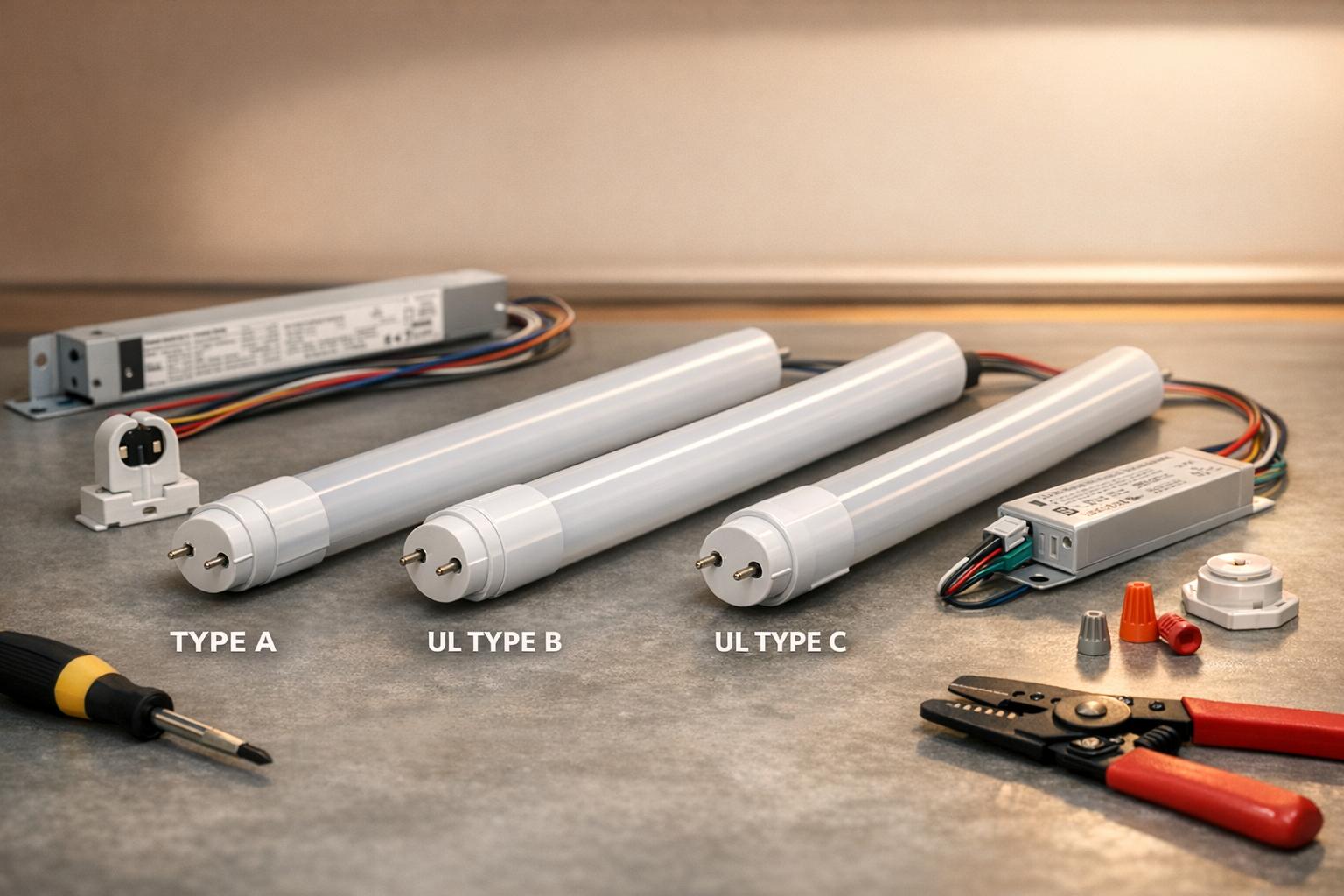
LED retrofits can drastically cut energy use and improve lighting in commercial spaces - but only if the fixtures are compatible. Choosing the right retrofit type (UL Type A, B, or C) is crucial to avoid issues like flickering, electrical hazards, or reduced lifespan. Each option has unique installation, efficiency, and maintenance needs:
Key considerations include inspecting fixtures for wear, verifying socket configurations, and ensuring compatibility with lighting controls. Proper planning and expert guidance can lead to energy savings of up to 60%, with additional savings from advanced controls. Always check for outdated components like ballasts or sockets before starting a retrofit project.
Quick Comparison:
| Feature | UL Type A | UL Type B | UL Type C |
|---|---|---|---|
| Installation | Plug-and-play | Requires rewiring | Complex (driver) |
| Efficiency | Lowest (Ballast) | Higher (No ballast) | Highest |
| Maintenance | Ballast required | No ballast | Replaceable driver |
| Safety Risk | Low | Medium (Shock risk) | Low |

LED Retrofit Types Comparison: UL Type A vs B vs C
Choosing the right LED retrofit is crucial for ensuring your lighting system performs well and lasts over time. LED retrofits are generally divided into three categories, each with its own set of compatibility needs and installation considerations.
The UL Type A retrofit, also called ballast-compatible, is designed to work with your existing ballast. This makes installation as simple as plugging in the LED replacement. However, the performance of the LED depends heavily on the condition of the ballast. If the ballast is older than five years, it may fail before the LED reaches the end of its rated lifespan. Another limitation is that you’re restricted to LED models specifically made for your ballast type, and the ballast itself consumes an extra 2–4 watts per fixture.
For UL Type B retrofits, also known as ballast bypass, the ballast is removed entirely, and the LED connects directly to the line voltage, typically in the range of 120–277V. This eliminates the compatibility issues tied to the ballast and provides an extra 5–10% energy savings by cutting out the ballast’s power draw. However, rewiring the fixture is required, and this work must be performed by a licensed electrician. As OEO Energy Solutions explains:
The advantage of wiring around or removing the ballast is an additional 5-10% in energy savings. And you completely eliminate the ballast as a future failure point.
To ensure safety during Type B installations, label fixtures appropriately and incorporate fast-acting fuses to reduce electrical hazards.
The UL Type C retrofit uses an external LED driver separate from the LED module. This setup offers excellent thermal management by placing the heat-generating driver away from the LED, which can extend the lifespan of the system to about 50,000 hours. It also allows for better dimming control and increased overall efficiency. However, this option involves more complex installation steps, including removing the old ballast and sockets, mounting the new driver, and fully rewiring the fixture. This makes it a more expensive and labor-intensive choice.
| Feature | UL Type A | UL Type B | UL Type C |
|---|---|---|---|
| Installation | Plug-and-play; no rewiring | Requires rewiring by an expert | Requires external driver installation |
| Efficiency | Lowest (affected by ballast) | Higher (5–10% energy savings) | Highest efficiency |
| Maintenance | Ballast maintenance needed | No ballast maintenance | Driver can be replaced separately |
| Safety Risk | Low (no rewiring required) | Higher (shock risk) | Low (operates at low voltage) |
| Labor Cost | Lowest (DIY possible) | Moderate (electrician needed) | Moderate |
Another factor to consider is the type of fixture sockets, which can significantly impact the success of a retrofit. For Type B installations, the socket configuration is particularly important. Fixtures with shunted sockets - commonly found in instant-start fluorescent fixtures - require dual-ended LED tubes, while non-shunted sockets are compatible with single-ended tubes. Using the wrong combination can lead to a short circuit. Always check your socket configuration before deciding on a retrofit type to avoid compatibility issues.
Recessed can fixtures are a popular choice, but they come with their own set of challenges. One major issue is heat buildup. These fixtures can trap heat, which reduces the light output and shortens the lifespan of the LED driver. While recessed cans can save up to 80% in energy costs, these savings depend heavily on proper thermal management.
Voltage mismatches are another common problem. For instance, installing a 120V LED in a 277V socket or pairing it with an outdated HID ballast can lead to rapid failure. Sri Rahm, Senior Lighting Application Specialist at GE, cautions:
Just because a lamp screws into the socket and makes electrical contact does not mean that contact is electrically sound.
It's crucial to verify the socket voltage before installation to avoid costly errors.
Another consideration is how LEDs emit light. LEDs are directional by nature, which can result in uneven lighting or dark spots if not carefully managed. This issue can be compounded when existing dimmers are incompatible with the LEDs unless both meet standards like NEMA SSL-7A. Tom Divine, Senior Electrical Engineer at Smith Seckman Reid Inc., explains:
LEDs, at the component level, are generally directional emitters... lower-end retrofit kits may present a more directional illumination pattern than the original fixtures, resulting in dark spots between fixtures.
While recessed cans have specific thermal and voltage challenges, HID fixtures bring a different set of optical and structural issues.
HID fixtures are tricky to retrofit due to their design. The main issue lies in light distribution. These fixtures rely on reflectors and lenses optimized for the 360-degree light output of HID bulbs. When you replace these with directional LED bulbs, often referred to as "corn cob" lamps, the results can be less than ideal. You might notice shadowing, sharp cutoffs along walls, or uneven lighting. Additionally, retrofitting can cause 10–15% light loss due to trapped inter-reflections.
Another concern is socket degradation. Prolonged use of HID bulbs can wear down ceramic sockets, which may need replacement for safety reasons. Fitment issues are also common, as LED replacement bulbs are often larger or heavier than the original HID bulbs, potentially straining the lamp holders.
The ballast adds another layer of complexity. If the ballast is over five years old, Type A retrofits are not recommended since the ballast is likely to fail before the LED reaches its rated lifespan. Opting for a ballast bypass (Type B) retrofit eliminates this issue, but it requires an electrician for rewiring. Keep in mind, once you bypass the ballast, standard HID bulbs can no longer be used in that fixture.
Here’s a quick comparison of common retrofit types:
| Retrofit Type | Ballast Usage | Installation Complexity | Efficiency | Key Challenge |
|---|---|---|---|---|
| UL Type A | Uses existing HID ballast | Low (Plug-and-play) | Lowest | Ballast incompatibility/failure |
| UL Type B | Bypasses/Removes ballast | Medium (Requires rewiring) | High | Safety risk during installation |
| UL Type C | Replaces with LED driver | High (Component swap) | Highest | Highest upfront material cost |
Before committing to a large-scale retrofit, it’s wise to test a few fixtures first. This allows you to evaluate light levels, distribution, and the overall appearance of the space. Taking this step can help you avoid costly mistakes and ensure the retrofit meets your expectations.
Switching to LED lighting retrofits can lead to noticeable energy savings, though the extent of these savings depends on the specific retrofit approach. In commercial buildings, lighting typically makes up about 20% of total electricity use. Retrofitting fluorescent troffers with LEDs can reduce energy consumption by anywhere from 20% to 60% on a project level.
The choice of retrofit method greatly impacts efficiency. For instance, UL Type A retrofits generally save around 20%, while opting for full luminaire replacements or retrofit kits can push savings to 60% or more. According to the U.S. Department of Energy, "the fluorescent ballast will limit the energy efficiency of the luminaire. UL Type A TLEDs are the least efficient of the TLEDs". To put this into perspective, replacing a 74W T12 fluorescent fixture with a 42W LED equivalent can cut annual operating costs from $18.74 to $10.63 per fixture, assuming 3,000 hours of operation. These technical decisions play a critical role in determining energy performance.
Adding lighting controls, like occupancy sensors, can boost energy savings by an average of 28%. Pairing LED retrofits with advanced controls - such as networked systems, daylight dimming, and automated shades - can drive total savings beyond 70%. Some projects that integrate advanced controls have even achieved energy reductions of over 80%.
While energy efficiency is a key advantage, maintaining high light quality is equally important to get the most out of retrofits. Traditional troffers lose 25–35% of generated light, but LEDs, with their directional lighting, minimize this loss and deliver more lumens exactly where they’re needed. To ensure at least a 10% energy improvement over standard fluorescent tubes, TLEDs should offer a minimum efficacy of 110 lumens per watt. Additionally, it’s crucial to verify that retrofit products are listed on the DesignLights Consortium (DLC) qualified products list. This ensures they meet specific performance and color quality standards.
Before starting a retrofit, measure the existing light levels and avoid UL Type A installations if the ballasts are more than five years old. This approach helps maximize both efficiency and performance.
Before diving into an LED retrofit, take the time to physically inspect your existing fixtures. Look for signs of wear and tear, such as frayed wiring, damaged sockets, corroded parts, or lenses that have become discolored. If you notice severe issues - like yellowed reflectors or heavily corroded housings - it might make more sense to replace the entire fixture instead of just swapping out the lamps.
Check the age of your ballasts, as UL Type A retrofits typically require ballasts that are less than five years old. Also, confirm the socket type. Some retrofits are designed for non-shunted sockets, while others need shunted configurations to function correctly.
Take a close look at the ceiling plenum and the housing space above your fixtures. Limited access or hazardous materials like asbestos can complicate the installation process and increase costs. Additionally, contoured housings may not accommodate certain retrofit kits, so it’s important to ensure compatibility. To set a baseline for your new LED lighting, use a light meter to measure the current light levels in foot-candles.
Don’t overlook the controls. Check if your existing dimmers, occupancy sensors, or building automation systems will integrate with the new LED drivers. Occupancy sensors alone can reduce energy costs by an average of 28%.
Once your audit is complete, consult with experts to develop a comprehensive retrofit plan.
Working with lighting professionals can help you navigate the technical challenges of retrofitting. Experts can determine whether your current ballasts are compatible with UL Type A TLEDs, or if you’ll need to consider a ballast bypass (Type B) or an external driver (Type C) solution. They’ll also ensure your retrofit complies with the National Electrical Code (NEC) and meets the standards set by your local Authority Having Jurisdiction (AHJ), keeping your fixtures safe and up to code.
"Ballasts vary and it cannot be assumed that all ballasts will work with all TLEDs. Fixture manufacturers supply different ballasts in the same fixture line... which could lead to compatibility issues with some fixtures in a project." – U.S. Department of Energy
Professionals can also conduct photometric studies to address potential issues like uneven lighting or overly bright areas, which could violate NFPA 101 Life Safety Code requirements for egress paths. They may suggest mock-up installations to test for flicker, glare, and actual light levels in your specific space before moving forward with a large-scale rollout.
For example, Texas Lighting Consultants specializes in helping commercial, educational, and municipal facilities across Texas achieve energy savings while maintaining safety and compliance. Their expertise ensures that every retrofit project meets performance expectations and adheres to regulations.
Additionally, experts can guide you toward DLC-listed products and help you take full advantage of available utility rebates, making your retrofit both efficient and cost-effective.
Ensuring fixture compatibility is a key step in achieving both safety and energy efficiency during LED retrofits. Ignoring compatibility can lead to serious issues, such as voided safety certifications, electrical shock hazards, and flickering lights that violate life safety codes. On top of that, selecting the wrong retrofit method might leave you falling short of the energy savings you expect.
It's essential to align your retrofit type with your existing setup. For instance, if your ballasts are more than five years old, steer clear of UL Type A TLEDs. Instead, consider UL Type B or Type C options, which eliminate the need for aging components. Pay close attention to factors like socket types, control system compatibility, and whether emergency lighting systems will function properly after the upgrade. As Rudolph R. Verderber of the Building Technologies Department puts it:
"Lighting retrofits do not meet their expectations when decision making criteria are based solely upon economics." – Rudolph R. Verderber
Evidence from real-world projects underscores the importance of addressing compatibility. One case study highlights how proper planning led to significant cost and energy savings.
To ensure success, consult lighting professionals who are well-versed in National Electrical Code requirements, UL classifications, and advanced control integration. With the right expertise, you can enhance energy efficiency by up to 28%. Texas Lighting Consultants specializes in guiding commercial, educational, and municipal facilities through these technical challenges, ensuring your retrofit is safe, efficient, and fully compliant with all relevant codes.
UL Type A LED retrofits are designed to function with the existing fluorescent ballast, making them a straightforward choice for installation. On the other hand, UL Type B retrofits bypass the ballast entirely, connecting directly to the line voltage. While this approach can cut down on maintenance needs, it might require some rewiring. Then there’s UL Type C retrofits, which use an external LED driver to power the LEDs. This setup offers greater flexibility and enhanced performance options.
Each type comes with its own advantages. When choosing the right retrofit for your fixtures, it's essential to weigh factors like energy efficiency, ease of installation, and long-term maintenance needs.
When upgrading your lighting, the first step is to figure out the type of ballast or driver in your current fixture. This will help you choose the right LED retrofit kit. Options include Type A (works with existing ballast), Type B (requires bypassing the ballast), or Type C (uses an external driver). Be sure to check the manufacturer's details to ensure the kit matches your wiring setup and dimmer system.
If you're unsure, it might be worth getting a professional evaluation. Experts, like those at Texas Lighting Consultants, can conduct a site review to confirm that your retrofit meets energy efficiency standards and performs at its best.
When it comes to UL Type B LED retrofits, there are a few hurdles to keep in mind. These retrofits require bypassing or removing the ballast and rewiring the fixture, which, if done incorrectly, can lead to safety hazards or even void your warranty. Plus, older wiring or sockets might not play well with these upgrades, potentially causing performance issues or shortening the LED's lifespan due to overheating.
To keep things running smoothly and safely, it’s essential to stick to UL safety standards during installation and confirm that your fixtures are compatible with this type of retrofit. Bringing in a professional or a seasoned lighting specialist can be a smart move to sidestep any issues and make the most out of your lighting upgrade.
We’re a HUB-certified Texas lighting company specializing in surveys, calculations, and installations for government and contractor projects.
© 2025-26 | Texas Lighting Consultants | All Right Reserved.