August 6, 2026
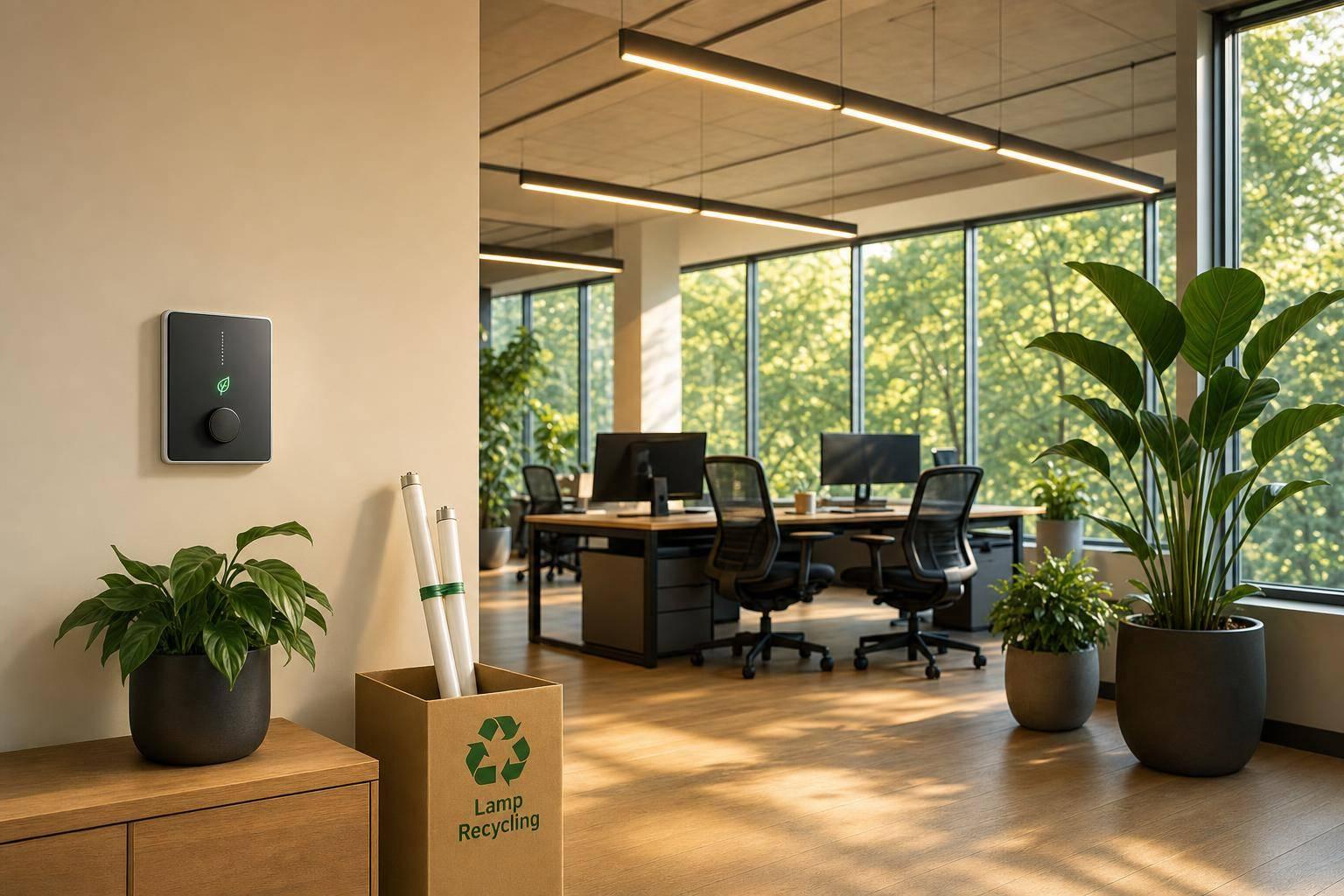
Lighting upgrades cut power use, lower emissions, reduce cooling demand, and shrink waste. In many commercial buildings, lighting uses about 35% of electricity, and every 1 kWh saved from lighting can trim HVAC use by about 0.4 kWh. That means a lighting project can lower both electric load and air-conditioning load at the same time.
If I had to sum up the article in a few points, it would be this:
Here’s the core idea: if you want to cut the impact of a building’s lighting, I’d look at three things at once - fixture efficiency, controls, and proper disposal of old equipment.
A simple before-and-after review should include:
Bottom line: lighting upgrades are not just about lower utility bills. They also cut heat, emissions, and landfill waste while helping Texas facilities stay within code.

Most of a lighting system’s impact comes during the years it’s switched on and drawing power. That’s why efficiency upgrades go after the biggest source of emissions and resource use first.
LED lighting uses less electricity than fluorescent or HID systems, which cuts power demand and the emissions linked to generation. Put simply: when a building uses less electricity for lighting, it also drives down the pollution tied to that electricity.
LEDs also give off less waste heat. That matters because excess heat doesn’t just disappear - it makes the building’s cooling system work harder. As the GSA notes:
"Choosing the most efficient lamp and appropriate control minimizes the amount of waste heat generated, allowing the cooling system to run more efficiently."
Lower indoor heat can also help the HVAC system run more efficiently.
LEDs last longer than incandescent, fluorescent, or HID lamps. That means fewer replacements, less material waste, and fewer spent lamps to deal with over time. In spaces with high ceilings, longer lamp life also means less maintenance disruption, which can make a big difference in day-to-day building operations.
These gains get even better when LEDs are used with controls that reduce run time and stop wasted light output.
Lower wattage is the next big lever for cutting lighting energy use. LED retrofits reduce fixture wattage, and controls reduce run time. Put those two together, and a building uses a lot less power. The biggest drops usually happen when new fixtures are paired with occupancy sensors, daylight controls, and scheduling.
In offices and schools, 4-lamp T8 troffers that draw about 96 W can drop to 30–40 W with LED troffers or retrofit kits. Warehouse high-bays and exterior fixtures often see similar 50% cuts in fixture wattage.
That kind of drop adds up fast at scale. DOE Interior Lighting Campaign projects averaged 54% energy savings across more than 2.8 million upgraded fixtures and controls.
LEDs cut how much power a fixture uses. Controls cut how long that fixture runs - and how bright it needs to be.
Occupancy sensors turn lights off after a space empties, with measured savings of 23–26% of lighting energy in office settings. Vacancy sensors do much the same thing, but they require someone to turn the lights on manually, which makes them a good fit for classrooms and private offices. Daylight harvesting dims electric lighting when there’s enough daylight near perimeter zones and skylights, adding another 25–60% reduction in those areas. Scheduling controls keep lights from running at full output at night, on weekends, or during off-hours in places like lobbies, corridors, and parking lots.
Layer those control strategies onto an LED retrofit, and total lighting energy savings often land in the 50–70% range compared with the original baseline system. In warehouse and industrial spaces with legacy HID systems running for long hours, documented savings have reached 60–80%.

Texas Lighting Consultants helps Texas facilities review existing lighting, pair fixtures and controls with the needs of each space, and confirm performance after installation. They also help with rebate programs and compliance documentation for public-sector facilities working through utility incentives and energy code rules.
Savings tend to last when the upgrade also aligns with Texas energy-code and outdoor-lighting requirements.
Lighting upgrades in Texas need to meet both state energy code rules and local outdoor-lighting ordinances. That matters for a simple reason: too much light wastes power and adds to light pollution. If you plan for both up front, you can avoid tearing work back out later.
Texas commercial projects follow the IECC and ASHRAE 90.1. And the rules on lighting power have gotten tighter. So when you're planning a retrofit, start with the W/ft² limit for each space type.
Reviews of Texas code updates show a weighted average lighting power density drop of about 0.44 W/ft² across building types. In day-to-day design, interior lighting power is capped at 90% of IECC table values, which puts an office at about 0.82 W/ft².
That means fixture efficiency alone won't carry the job. Controls matter just as much, and they aren't optional if you want compliance. Occupancy sensors are required in enclosed offices, classrooms, and warehouses. Time-based shutoff controls help stop lights from running all night. Daylight-responsive dimming is also required in sidelit and skylit zones once the wattage thresholds apply.
Put simply: choose fixtures and controls as one package, not as two separate decisions.
Outdoor upgrades affect power use, glare, and skyglow. In Texas, there's another layer to watch when state money is part of the project. Texas Health and Safety Code Chapter 425 applies to outdoor lighting paid for with state funds.
Under that law, fixtures that produce more than 1,800 lumens must be full cutoff luminaires, which means no light goes above the horizontal plane. The law also requires the minimum light level needed for the task and calls for full consideration of energy conservation, glare reduction, minimizing light pollution, and preserving the natural night environment.
Local ordinances can add tighter limits. They may cap total lumen output, require full cutoff fixtures, or set a color temperature limit. For example, Lago Vista caps nonresidential outdoor light output at 100,000 lumens per acre, and Kendall County limits color temperature to 3,000 K. Some local rules also require lighting to be dimmed by 50% after 11:00 p.m. unless it is motion-activated.
That's why local review needs to happen before fixture selection, not after. For parking lots and similar areas, full cutoff LED luminaires paired with adaptive controls can help meet safety, energy, and light-pollution targets. Check the current energy code and the local outdoor-lighting rules before you lock in fixtures.
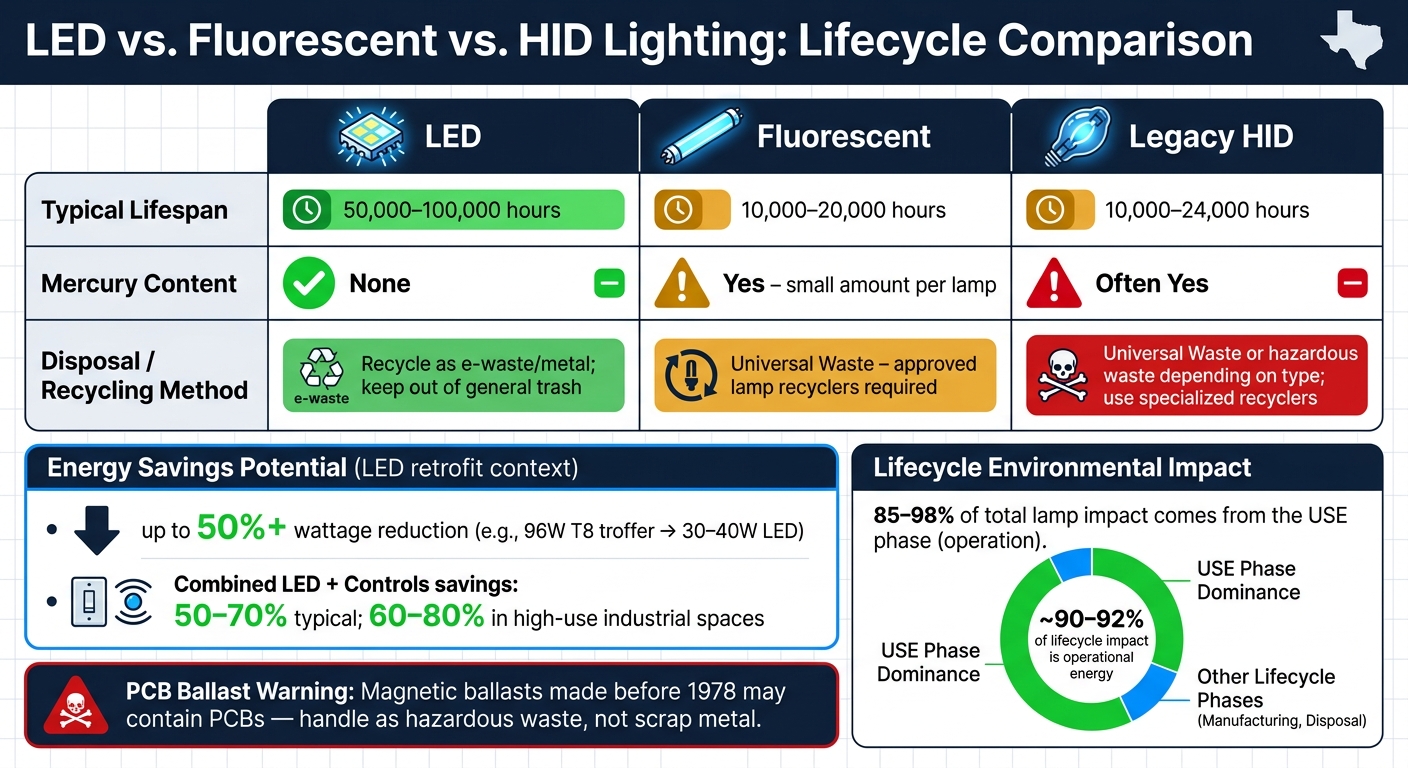
LED vs. Fluorescent vs. HID: Lifespan, Savings & Disposal Guide
Energy savings do most of the heavy lifting, but materials and disposal still shape the total impact.
For most lighting systems, the biggest environmental cost comes from operation. IEA 4E research found that 85–98% of a lamp's total environmental impact comes from the use phase, while manufacturing and end-of-life account for the rest. For LEDs, about 90–92% of lifecycle impact is tied to operational energy.
That shifts the main goal into focus: cut electricity use first.
At the same time, fixture choice still matters. Durable, properly sized fixtures can reduce embodied carbon from raw materials, manufacturing, and replacement waste. When a system lasts longer, you also cut down on packaging, shipping, and labor tied to repeat changeouts.
During a retrofit, old lamps and ballasts need proper handling. This part isn't optional.
Mercury-containing lamps - including fluorescent and many HID types - are classified as Universal Waste under U.S. EPA rules and Texas regulations. That means they need universal-waste handling. They must be kept in closed, labeled containers, stored for no more than one year, and sent to a qualified recycler.
Older magnetic ballasts manufactured before 1978 need extra care. Many contain PCBs and must be handled as hazardous waste rather than recycled as scrap metal. If a ballast is not marked Non-PCB and you can't verify it, treat it as PCB-containing until you know otherwise.
LEDs contain no mercury, and their aluminum housings and circuit boards can usually go to e-waste or metal recycling. Typical end-of-life traits for common lighting types are shown below.
| Technology | Typical Lifespan | Mercury Content | Disposal / Recycling |
|---|---|---|---|
| LED | 50,000–100,000 hours | None | Recycle as e-waste/metal; keep out of general trash |
| Fluorescent | 10,000–20,000 hours | Yes (small amount per lamp) | Universal Waste; approved lamp recyclers required |
| Legacy HID | 10,000–24,000 hours | Often yes | Universal Waste or hazardous waste, depending on type; use specialized recyclers |
Once the old equipment is out, document what was removed before you commission the new system. That paper trail matters more than people think.
After installation and disposal are done, check the upgrade with a simple before-and-after review.
Track:
Compare pre- and post-upgrade electricity use based on fixture counts, wattages, and operating hours. Then convert kWh savings to CO₂ using your utility's emission factor or a standard U.S. average.
Public-sector facilities in Texas should prepare a baseline report before the upgrade begins. Include fixture types, wattages, quantities, and estimated annual hours. Then record the new fixture models, control strategies, and installation dates in a standard template. This supports rebate claims, ESG reporting, and audits.
Texas Lighting Consultants provides rebate assistance and compliance documentation as part of its turnkey upgrade process, which helps facilities keep this paperwork organized.
A lighting upgrade affects more than the power bill. Efficient LED fixtures lower energy use, cut emissions, reduce heat load in conditioned spaces, and shrink maintenance waste over the life of the system. Controls help stop lights from running in empty spaces or in areas that already have enough daylight. Texas energy codes and outdoor lighting rules also steer upgrade choices toward better-performing, lower-impact systems. And proper disposal of mercury-containing lamps and PCB ballasts helps keep hazardous material out of landfills.
Track kWh, kW, maintenance, and waste so you can show the results with actual numbers.
Lighting upgrades can cut emissions in a big way because they lower energy use. And that matters, since lighting often accounts for 15% to 40% of a commercial building’s electricity use.
One of the biggest changes is switching to LED lighting. That move alone can cut lighting energy use by 20% to 90%. That’s a wide range, but even on the low end, the savings can be hard to ignore.
Add smart controls like occupancy sensors and daylight harvesting, and total lighting energy savings can go past 70% to 80%. Put simply, the system uses light when and where it’s needed instead of burning power all day for no good reason.
There’s also another upside people sometimes miss: LEDs give off less heat. Less heat from lighting can reduce HVAC cooling demand, which means the building may use less power beyond lighting itself.
The biggest savings usually come from pairing LED upgrades with layered automated controls.
Here’s the simple version: LEDs save power on their own, but controls push those savings much further.
If you want control across the whole building, connecting these systems to a building automation platform adds another layer. That setup can reduce lighting energy use by an extra 20% to 60% through centralized scheduling and real-time monitoring.
During a lighting retrofit, old equipment needs to be recycled or disposed of the right way. That helps protect the environment and keeps your facility in line with regulatory requirements. Fluorescent tubes need extra care, since improper handling can lead to mercury contamination.
Many parts from older lighting systems can be recycled instead of sent to the landfill. Texas Lighting Consultants can also handle the required recycling documentation, which makes it easier for your facility to stay compliant and environmentally responsible.

We’re a HUB-certified Texas lighting company specializing in surveys, calculations, and installations for government and contractor projects.
© 2025-26 | Texas Lighting Consultants | All Right Reserved.