March 5, 2026
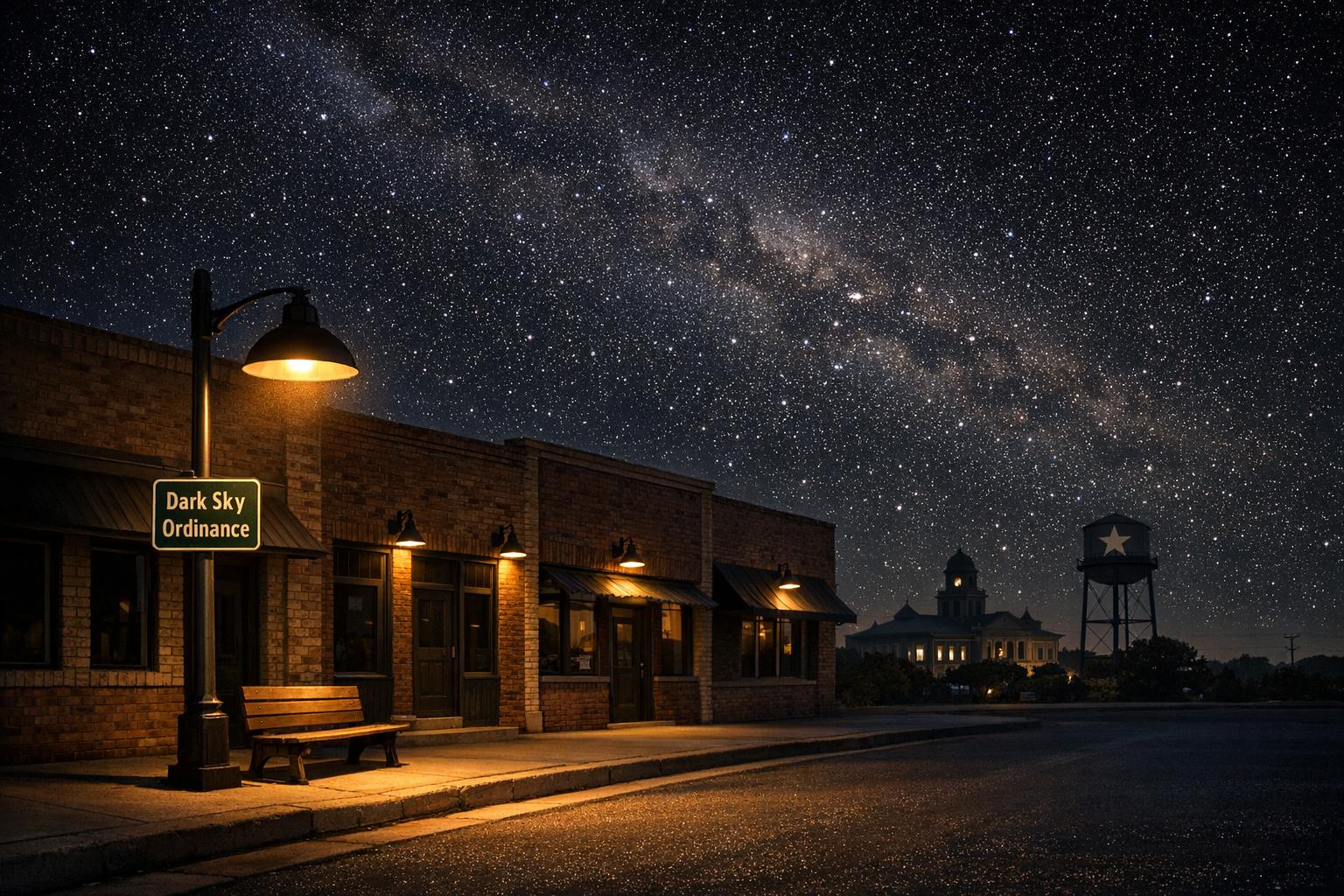
If you’ve noticed how light pollution dims Texas’s famous night skies, you’re not alone. Cities across the state are addressing this issue through dark sky ordinances. These measures aim to reduce unnecessary outdoor lighting, protect wildlife, save energy, and support stargazing and tourism. Key initiatives include:
Cities like Dripping Springs, Wimberley, and Bee Cave have adopted strict rules, earning International Dark Sky Community certification. Efforts like "Lights Out Texas" also help protect migratory birds. State laws, such as Senate Bill 1090, allow cities to enforce these regulations, especially near observatories like McDonald Observatory.
Reducing light pollution not only restores the night sky but also cuts energy waste - saving up to $7 billion annually in the U.S. - and minimizes CO₂ emissions. Complying with these ordinances often requires businesses to modify lighting systems, but experts like Texas Lighting Consultants can help navigate these changes effectively.
Texas state law outlines how outdoor lighting is regulated, with specific rules varying based on location and community type. These laws provide a framework for local governments to follow, influencing both commercial and municipal lighting projects.
These sections focus on protecting the McDonald Observatory in West Texas by requiring nearby municipalities to adopt strict outdoor lighting ordinances. The law applies to areas within a 57-mile radius of the observatory, covering roughly 28,000 square miles in counties like Jeff Davis, Brewster, Presidio, Hudspeth, Culberson, Reeves, and Pecos.
"The governing body of a municipality by ordinance shall regulate the installation and use of outdoor lighting... designed to protect against the use of outdoor lighting in a way that interferes with scientific astronomical research of an observatory." – Texas Local Government Code Section 229.053
Municipalities in this zone must enforce permits, shielding requirements, and usage controls for outdoor lighting. Subdivision plats must also comply with these standards, and violations are treated as Class C misdemeanors. However, the law exempts lighting installed or under construction before January 1, 2012, as well as utility-owned lighting.
Senate Bill 1090 introduced an important update, allowing cities to regulate lighting if they declare their intent to become an International Dark Sky Association (IDA) certified community. This change permits municipalities to extend lighting regulations into their extraterritorial jurisdiction (ETJ).
The bill also shifted enforcement from criminal to civil penalties, with fines for violations capped at $500. Existing lighting is grandfathered until the later of September 1, 2026, or five years after the ordinance is adopted. For residential properties with four or fewer units in the ETJ, existing lighting is protected unless the property undergoes renovation.
Texas boasts several cities - like Dripping Springs, Wimberley, and Bee Cave - that have earned the prestigious International Dark Sky Community (IDSC) certification. These communities stand out for their commitment to reducing light pollution through strict lighting rules. The guidelines include full shielding, limits on brightness (lumen caps), and restrictions on color temperature, ensuring outdoor lighting remains functional yet gentle on the night sky.

The Wimberley Valley, which encompasses Wimberley and Woodcreek, became Texas's third IDSC-certified area in June 2018. Home to about 14,000 residents, it was even named International Dark Sky "Place of the Year" in 2023. Achieving this status required adopting strict lighting laws, educating the public, and fostering community involvement.
"As a dark-sky friendly community, Wimberley will now be recognized around the world as a place where our natural surroundings are protected and as a place where you can enjoy starry nights." – Cathy Moreman, Executive Director, Wimberley Valley Chamber of Commerce
This recognition has also turned Wimberley into a hotspot for astrotourism, drawing stargazers eager to experience its pristine night skies.
Dripping Springs holds the distinction of being Texas's first International Dark Sky Community, earning the title in January 2014 and becoming only the sixth worldwide to achieve this recognition. The city's journey began in 2011 when local leaders implemented a comprehensive lighting ordinance.
The ordinance (Article 24.06) sets clear limits: 100,000 lumens per net acre for nonresidential properties and 25,000 lumens per net acre for residential areas. Lighting must also meet a 3,000 Kelvin (K) or lower rating to curb blue light pollution, and lights cannot spill onto neighboring properties. Nonresidential lighting is further reduced to 25% or less of its allowed output within 30 minutes of closing, and advertising signs must be turned off by 10:00 p.m..
Local businesses have embraced these standards. For example, an H-E-B grocery store installed shielded LED lights, reducing its light intensity to 10 foot-candles, as recommended by the Illuminating Engineering Society. O'Reilly Auto Parts took additional steps by applying dark film to its windows to prevent interior light from escaping.
"The technology is there to do lighting well. Dripping Springs is full of good lighting. Awareness, education; it's 10 percent hardware and 90 percent education." – Bill Wren, McDonald Observatory
The city also treats excessive light as "trespass", with violations subject to fines. Sports facilities face a curfew of 10:30 p.m., and Dripping Springs committed to upgrading all city-owned lighting within five years of certification.

Bee Cave joined the ranks of IDSC-certified communities in April 2023, following the adoption of a new lighting ordinance in 2022 that aligns with DarkSky standards. Led by Mayor Kara King and backed by community support, the ordinance covers the city’s 6.8 square miles and an 8.3 square mile extraterritorial jurisdiction (ETJ).
The Lake Travis Youth Association (LTYA) Sports Fields became Texas's first sports complex certified under DarkSky's Outdoor Sports Lighting Program in 2022. The complex utilized specialized lighting designed to reduce glare and light spill, receiving praise from neighbors and city officials alike.
"Since installing dark-sky certified lights, we have had nothing but compliments from our neighbors, city staff, city officials, and our families." – Scott Cronk, Lake Travis Youth Association Sports Fields
"Being a dark sky community is a wonderful way to remind our residents that there is magic above us and we are lucky to live in an area that allows them to enjoy it." – Kara King, Mayor of Bee Cave
Bee Cave’s efforts also extend to protecting the endangered Golden-Cheeked Warbler, showcasing how dark sky initiatives can enhance both community life and natural habitats. Next, we’ll explore how other Texas cities are embracing similar ordinances.

Texas Dark Sky Ordinance Requirements by City Comparison Chart
Several cities in Texas, including Alpine, Austin, and San Antonio, have implemented lighting ordinances aimed at reducing light pollution. These efforts build on the practices of internationally certified Dark Sky Communities. However, legislative changes in 2021 have imposed restrictions: only certified Dark Sky Communities or cities near large observatories or military sites can enforce new lighting regulations.
State law sets a baseline for lighting projects. According to the Texas Health and Safety Code Chapter 425, any lighting fixture funded by the state that produces over 1,800 lumens must use a cutoff luminaire, which is comparable to a 100–150 watt incandescent bulb. This rule ensures that state-funded lighting projects meet basic standards for reducing light pollution.
Most city ordinances share similar requirements, such as:
Cities near the McDonald Observatory, like Alpine and Marfa, enforce stricter standards to protect the International Dark Sky Reserve. Let’s dive into some specific city ordinances and how they vary.
Ordinances differ significantly across Texas cities, tailoring their rules to local needs and priorities.
"The intent of the ordinance is to decrease light pollution to maintain Heath's quaint rural character, maintain property safety, preserve views of the night sky, and promote energy efficiency." – City of Heath
The table below highlights key differences among select cities:
| City | Shielding Requirement | Max Color Temperature | Timer/Curfew Requirements |
|---|---|---|---|
| Alpine | Fully shielded; light must project downward | 2,700K | 5-year compliance timeframe (2021) |
| Heath | Fully shielded for fixtures ≥ 1,500 lumens | 3,000K or lower | 10:00 p.m. to one hour before sunrise |
| Blanco | Must not shine off property (light trespass) | 3,000K or less | Not specified |
| Lakewood Village | Fully shielded | Not specified | Not specified |
| State-Funded Sites | Cutoff luminaire for >1,800 lumens | Not specified | Not specified |
These variations in ordinances directly impact commercial lighting projects, often requiring detailed guidance from experts like Texas Lighting Consultants. It’s crucial to verify a city's certification status to determine whether it has the authority to enforce these rules under current state law. Additionally, municipalities generally cannot enforce lighting regulations within their extraterritorial jurisdiction (ETJ).
Dark sky ordinances are reshaping how businesses and municipalities approach outdoor lighting, emphasizing stricter technical standards. These regulations often require fully shielded fixtures that direct light downward to minimize light pollution. For instance, some cities enforce specific caps on outdoor lighting levels to comply with these rules.
Another key aspect is color temperature restrictions. Most ordinances limit commercial projects to warm LED lights, typically capped at 3,000K. However, sensitive areas like those near the McDonald Observatory in West Texas demand even lower limits, sometimes as low as 2,700K. This helps reduce blue light emissions, which can disturb wildlife and disrupt human sleep cycles. Additionally, many jurisdictions mandate automated controls to dim or turn off non-essential lighting between 10:00 PM and sunrise.
Property line illumination is also tightly regulated. Commercial sites near residential areas often face strict limits, such as a maximum of 0.1 footcandles at the property boundary, to prevent light trespass [21,24]. Violations of these rules can result in fines ranging from $200 to $1,500, with some West Texas areas imposing penalties up to $1,000 per violation [6,24]. These stringent requirements make compliance a detailed and essential process.
Understanding BUG ratings (Backlight, Uplight, Glare) is crucial for compliance, as these ratings measure light distribution. Many ordinances require fixtures to have a U0 rating, meaning they emit no upward light. Additionally, fixtures emitting over 1,500 lumens must often be fully shielded, though some West Texas areas extend this requirement to all outdoor lighting, regardless of output.
To meet these standards, businesses must provide photometric plans that outline fixture locations, mounting heights (usually capped at 20 feet), and boundary footcandle levels. For example, the City of Heath enforces a minimum Color Rendering Index (CRI) of 80 while maintaining a 3,000K temperature limit. Smart controls, such as motion sensors and timers, are also essential for adhering to curfew regulations without compromising safety.
"It makes sense for a municipality to establish clear guidelines for property owners, such as requirements for redirection of light, shielding of light, redesign or relocation of the light, replacement of the light, or removal of the light completely." – Judith El Masri, Attorney, Randle Law Office
Navigating these compliance hurdles often requires expert assistance.

Texas Lighting Consultants offers comprehensive solutions for ensuring compliance with dark sky ordinances, from design to installation. Their team evaluates non-compliant fixtures and creates plans that meet local standards, addressing everything from lumen caps to temperature limits.
They handle the technical aspects, including BUG rating calculations, photometric plan preparation for permits, and integration of smart controls to meet curfew requirements. Their expertise in energy-efficient LED retrofits not only ensures compliance but also reduces operating costs. Additionally, they help clients access rebate programs, offering incentives of up to $2,000 for switching to Dark Sky-compliant fixtures.
As a HUB-certified, woman-owned business, Texas Lighting Consultants understands the unique challenges of municipal procurement. They provide lighting solutions that meet ordinance standards while improving safety and visual comfort, from initial site assessments to post-installation checks.
Dark sky ordinances in Texas are reshaping how outdoor lighting is designed and implemented for both commercial and municipal projects. These regulations revolve around three main principles: shielding light fixtures to direct illumination downward, limiting color temperatures to 3,000K (or 2,700K in West Texas), and reducing light intensity to minimize waste and trespass. Recent legislative changes now allow certified Dark Sky Communities to enforce these measures more effectively.
The impact of wasteful lighting is staggering, costing nearly $7 billion annually and squandering 33% of outdoor lighting, all while contributing to environmental damage. For businesses in Texas, failing to comply with these standards can lead to fines ranging from $200 to $1,500 per violation, with some West Texas penalties reaching up to $1,000 per incident. On the flip side, cities like Alpine incentivize compliance by offering rebates - up to $2,000 - for switching to approved LED fixtures.
To meet these standards, properties must use U0-rated fixtures, develop precise photometric plans, and incorporate automated curfew controls. Additionally, any property receiving state funding must follow Texas Health and Safety Code Chapter 425, which requires cutoff luminaires for fixtures emitting more than 1,800 lumens. These technical requirements ensure energy-efficient lighting that aligns with regulatory expectations.
Beyond compliance, proper lighting design enhances safety, preserves wildlife habitats, and supports astrotourism. As Sarah Tober, President of Scenic Texas, explains:
"Dark sky legislation like SB 1090 has the potential to improve light pollution – the most easily reversible form of pollution – and the health of our environment, wildlife and migratory patterns, driving conditions, and the overall health of Texans".
In this changing regulatory environment, Texas Lighting Consultants provides end-to-end support - from assessments to installation - ensuring projects meet ordinance requirements while optimizing energy use and performance.
If you're wondering whether your city can legally enforce a dark sky ordinance, start by checking if it has adopted regulations that comply with state laws and international guidelines. Cities in Texas, such as Blanco and Alpine, already have enforceable ordinances in place. These typically include rules about outdoor lighting, like shielding fixtures and limiting brightness levels (measured in lumens). Texas legislation, including Senate Bill 1090, further empowers cities to establish enforceable measures aimed at reducing light pollution.
Dark-sky compliance upgrades aim to tackle light pollution by focusing on fixtures that direct light downward and reduce glare. This often means using full cutoff or shielded designs that block light from spilling upward or sideways. Additionally, opting for warmer color temperatures - 3,000 Kelvin or lower - helps minimize skyglow and light trespass. These changes not only preserve safety and functionality but also align with the dark-sky ordinances adopted by many municipalities in Texas.
To get a lighting permit under dark sky ordinances in Texas cities, start by reaching out to your local municipal or county office. You’ll likely need to submit a detailed lighting plan that outlines fixture types, shielding methods, and placement to ensure everything aligns with the regulations. For instance, Kendall County directs applicants to the Engineer's office, while cities such as Fredericksburg and Alpine may have their own specific standards and procedures. Be sure to confirm the exact requirements with your local permitting office.
We’re a HUB-certified Texas lighting company specializing in surveys, calculations, and installations for government and contractor projects.
© 2025-26 | Texas Lighting Consultants | All Right Reserved.