January 4, 2026
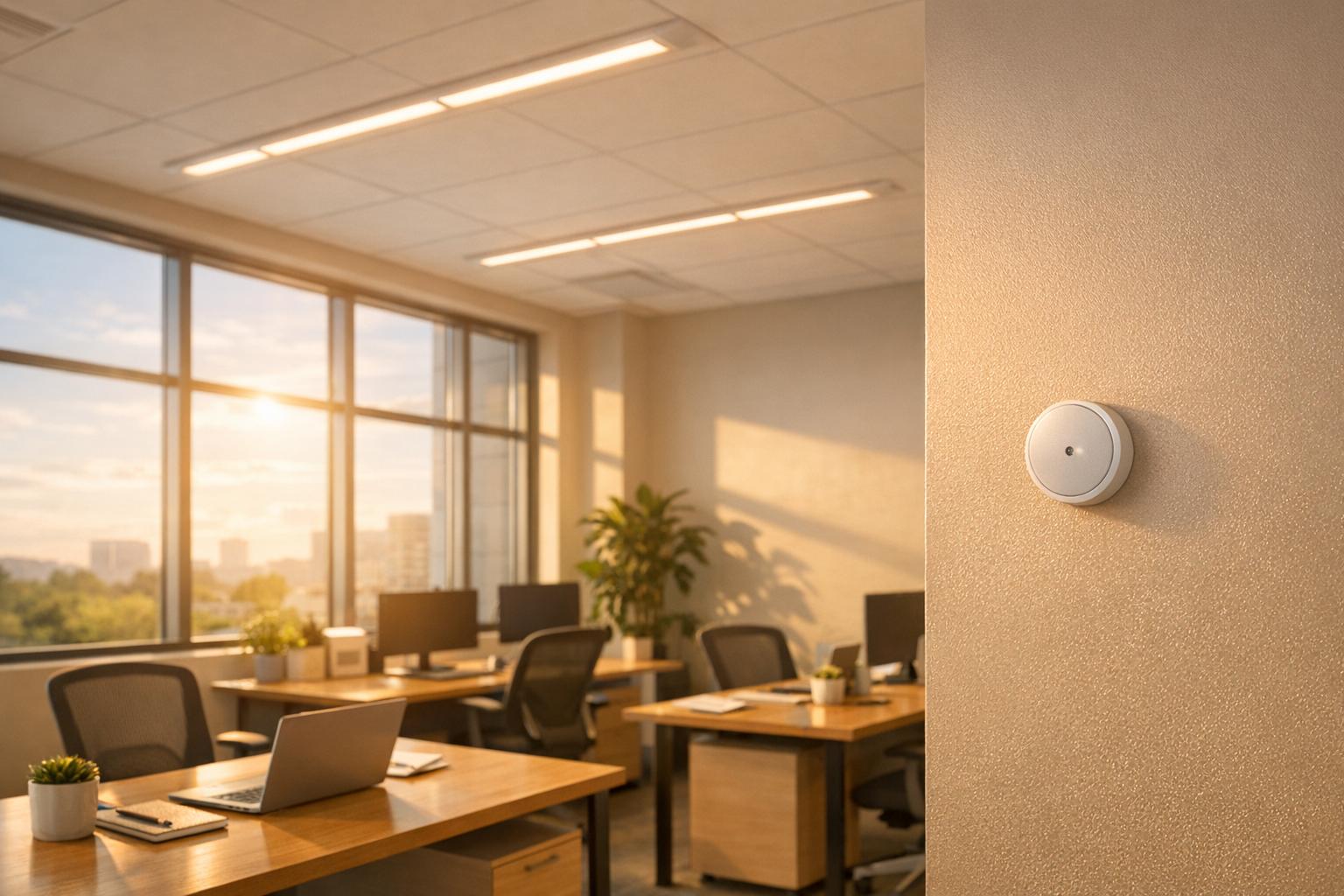
Daylight harvesting is an automated lighting system that uses sensors to adjust LED brightness based on natural light levels. This approach reduces energy use, extends LED lifespan, and improves indoor lighting quality. By integrating dimmable LEDs with photosensors and control systems, spaces can achieve up to 50–75% lighting energy savings, lower utility costs, and better occupant comfort. These systems also comply with energy codes like ASHRAE 90.1-2016 and often qualify for rebates, reducing installation costs.
Key Takeaways:
Daylight harvesting is ideal for offices, warehouses, and commercial spaces, especially those seeking energy efficiency and improved lighting quality. Proper commissioning and expert integration are critical for optimal performance.

Daylight Harvesting LED Systems: Energy Savings and ROI Benefits
Let’s break down how daylight harvesting systems work when combined with LED technology to create efficient, automated lighting solutions.
At the heart of a daylight harvesting system are three key components that work together seamlessly:
Together, these components automate lighting adjustments, ensuring optimal brightness with minimal energy waste.
Daylight harvesting systems operate automatically, removing the need for manual adjustments. Here’s how it works:
When sunlight streams through windows in the morning, photosensors detect the increased light and send this data to the control system. The system then dims artificial lighting to align with the pre-set illumination target, signaling LED fixtures to adjust accordingly.
As daylight fluctuates - whether due to passing clouds or the setting sun - the system continuously monitors and adjusts LED output to maintain consistent lighting levels. Modern solutions like Networked Lighting Controls (NLC) and Luminaire Level Lighting Controls (LLLC) take this a step further by embedding sensors into each fixture. These smart fixtures communicate wirelessly, addressing localized shading or glare issues in real time.
Advanced daylight harvesting systems integrate seamlessly with Building Management Systems (BMS), enabling coordination between lighting and other building functions. This integration unlocks features like:
A practical example of the benefits of integrated systems comes from the Energize Connecticut program in 2025. They offered tiered rebates to encourage adoption: $25 for a standard 2×4 linear LED luminaire, $70 for a fixture with an integrated dual sensor (occupancy and daylight), and $90 for full luminaire-level lighting controls.
Wireless communication protocols, such as Zigbee, play a crucial role, especially in high-ceiling spaces like warehouses where running low-voltage wiring would be costly. Additionally, cloud connectivity allows facility managers to monitor energy usage in real time, spot inefficiencies, and even detect driver failures before they disrupt operations.
Leora C. Radetsky, Senior Lighting Scientist at DLC, highlights the impact of these advancements:
"Using the control categories, we are helping our members provide more controls rebates and support incentive tiers - by making it easier for energy efficiency programs to connect integral lighting controls with control savings factors".
These smart systems not only enhance energy efficiency but also simplify facility management, making them a valuable asset in modern lighting design.
Daylight harvesting systems work by automatically dimming artificial lighting when natural light is sufficient, leading to significant energy savings. Under optimal conditions, these systems can cut lighting energy usage by 50–75%, with most installations averaging around 27% in annual savings. When paired with occupancy sensors and scheduling, the total energy savings can climb to 45% or more.
The financial perks go beyond just reducing energy consumption. By lowering peak electrical demand, these systems help reduce utility demand charges - a major expense for commercial buildings. For retrofits, the cost of installing daylight harvesting systems is roughly $1.40 per square foot if dimming drivers are already in place, with payback periods as short as four years.
Additionally, modern energy codes encourage these systems in commercial spaces, and utility rebates make them even more appealing. About 20% of utility programs now offer incentives specifically for lighting controls.
And it’s not just about saving energy and money - daylight harvesting also has a positive impact on the people inside these spaces.
Incorporating natural light into commercial spaces can dramatically improve the environment for occupants. Research from the National Renewable Energy Laboratory (NREL) shows that students in classrooms with ample daylight perform better on tests, and office workers exposed to natural light report lower stress levels.
These systems also allow for "task tuning", where light levels are adjusted to meet the specific needs of a workspace. This increases both visual comfort and functionality. In healthcare settings, natural light has been linked to faster recovery times for patients, while residents in assisted living facilities benefit from improved vision. These enhancements not only improve the overall experience but also contribute to higher employee productivity and retention.
The advantages of daylight harvesting don’t stop there - they also play a key role in meeting sustainability goals.
Daylight harvesting systems are a powerful tool for achieving sustainability certifications like LEED. They contribute points toward energy performance and indoor environmental quality. These systems also help buildings comply with stringent energy codes, including ASHRAE 90.1-2016, IECC, and California's Title 24.
For example, the NREL Research Support Facility - a 360,000-square-foot LEED Platinum building - achieved an impressive energy usage rate of just 0.15 watts per square foot, thanks in large part to daylight harvesting. Modern systems also integrate seamlessly with Networked Lighting Controls, which are recognized by standards like DLC SSL Version 6.0. This integration not only supports sustainability reporting but also allows facility managers to track environmental impact and align with corporate sustainability goals.
Start by analyzing how natural light flows through your building. Consider building orientation and whether nearby structures block sunlight. Pay attention to your floor-to-floor height and ceiling clearances, as these influence the window-to-floor area ratio and determine how far daylight can reach into the space.
Focus on high-traffic areas like open-plan offices, which benefit the most from daylight harvesting. However, spaces like storage rooms or areas requiring precision work may not be ideal. Make sure partitions and furniture don’t block light - low partitions (under 42 inches) or transparent materials work best.
Choose the right type of system based on ceiling height. For standard 9–10 ft ceilings, closed-loop sensors are effective, while open-loop sensors are better suited for larger spaces like warehouses or atriums with ceilings between 20 and 50 ft. These sensors measure natural light exclusively.
Check if your current lighting fixtures are compatible with advanced controls. This step can help you avoid unnecessary and costly upgrades.
Once you understand your space’s requirements, you can move on to selecting the appropriate equipment.
Dimmable LED fixtures are a must for smooth brightness adjustments. Look for products listed on the DesignLights Consortium (DLC) Qualified Products List, as this list is widely used across North America to determine eligibility for rebates - around 70% of commercial lighting programs refer to it.
The DLC SSL Technical Requirements Version 6.0, effective January 5, 2026, classifies LED products into seven control categories (0–6), making it easier to identify fixtures with built-in controls. Opt for products labeled as "DLC Premium" for advanced control features.
"Controls categories and the new controls option tables will also be helpful where codes or rebates require application-level controls usage such as daylight harvesting, high-end trim, and occupancy/vacancy sensing because the specific integral control capability will be shown in the table." - Leora C. Radetsky, Senior Lighting Scientist/LUNA Program Director, DLC
In spaces with ceilings over 30 ft, wireless connectivity is essential. Manual adjustments using scissor lifts are impractical at such heights. Additionally, ensure photosensors are rated for appropriate foot-candle ranges. For example, basic office sensors are sufficient for under 100 fc, but high-bay environments require sensors rated for 1,000+ fc to accurately measure light levels from 20–45 ft.
Don’t overlook emergency lighting requirements. Life-safety codes (UL 924) mandate that emergency lighting must override dimming during power outages, ensuring at least 1 fc average at floor level.
After selecting equipment, it’s time to evaluate the financial aspects of your project.
Your total investment will include dimmable LED drivers, photosensors, controllers, and commissioning labor for system tuning and testing. Fortunately, federal tax credits, state incentives, and utility rebates can lower your upfront costs by as much as 20% to 50%.
Rebates increasingly favor systems with integrated controls. For instance, in 2025, the Energize Connecticut program offered $25 for a standard 2×4 linear LED luminaire but boosted the rebate to $70 for the same luminaire with an integrated dual sensor and $90 for those with luminaire-level lighting controls (LLLC).
To calculate the payback period, divide the net project cost by annual energy savings. A payback period under three years is considered excellent. LED retrofits often achieve payback periods of 1 to 3 years, with an Internal Rate of Return (IRR) ranging from 30% to 60%. Use Net Present Value (NPV) calculations to factor in a 2–4% annual increase in energy prices.
Base your ROI estimates on real-world conditions, such as actual occupancy and shading. Over-shaded windows can reduce the amount of natural light available, extending the payback period. Focus on high-usage areas with expensive lighting for quicker savings. Finally, ensure professional commissioning - poor system tuning can compromise your energy savings.
Daylight harvesting with LED systems offers a powerful combination of energy savings and improved lighting performance. On average, these systems can achieve annual energy savings of around 27%, with potential reductions reaching up to 75% under ideal conditions.
Dimming LEDs not only saves energy but also minimizes driver heat, significantly extending the lifespan of fixtures from 10 years to over 30 years. This longevity helps cut down on maintenance costs. Beyond the technical advantages, incorporating natural light improves workplace comfort by supporting circadian rhythms, reducing eye strain, and lowering stress levels.
With modern energy codes requiring daylight-responsive controls and rebates covering as much as 75% of project costs, the financial and operational case for these systems is hard to ignore.
Proper daylight harvesting goes beyond installing new fixtures - it requires expert commissioning and precise integration of advanced sensors. As Verde Energy Efficiency Experts explain:
"Installing lights is one thing, but commissioning them with advanced sensors is another. Training and experience are critical in optimizing building tenant satisfaction, as well as energy savings".
Poor commissioning is one of the main reasons daylight harvesting systems fail to deliver the expected energy savings.
This is where Texas Lighting Consultants steps in. Our team specializes in the complexities of modern lighting controls, from understanding the differences between closed-loop systems for office spaces to open-loop systems designed for high-ceiling warehouses. We ensure sensors are placed and calibrated correctly from the start, helping facilities comply with energy standards like ANSI/ASHRAE/IES 90.1. Plus, we help secure utility rebates that can substantially lower project costs.
From the initial energy audit to the final commissioning phase, our expertise ensures your system performs at its best - delivering energy savings, longer equipment life, and enhanced comfort for occupants. In today’s fast-evolving landscape of lighting technology, having knowledgeable professionals on your side can mean the difference between meeting expectations and exceeding them.
Daylight harvesting systems play a key role in prolonging the lifespan of LED lighting. They work by automatically dimming or switching off lights when there's sufficient natural sunlight, cutting down the total operating hours of the LEDs. This reduces wear and tear, ensuring the lights last longer.
By decreasing both the intensity and duration of use, these systems also help lower thermal stress on the LEDs. This slows down lumen depreciation, preserving the brightness and performance of the lights over time. The result? A lighting system that not only lasts longer but also consumes less energy and requires fewer maintenance efforts, saving costs in the long run.
A daylight harvesting system operates through the combined efforts of three main components, working in sync to adjust electric lighting based on the amount of natural light available.
Other components, such as occupancy sensors, zoning infrastructure, and calibration tools, can refine the system's performance even further. Together, these elements create an automated lighting solution that reduces energy use, enhances comfort, and makes the most of available natural light.
Rebates and incentives can help cut down the upfront costs of installing daylight harvesting systems, making them a more affordable option. Programs such as federal tax credits, utility rebates, and municipal grants can cover a portion of the equipment and installation expenses. This reduces the overall project cost, shortens the time it takes to recoup your investment, and boosts your return on investment.
In Texas, lighting upgrades - like daylight harvesting sensors and dimmers - often qualify for utility-sponsored rebates and state-supported programs. Working with a knowledgeable provider like Texas Lighting Consultants can help you navigate these opportunities, ensuring you take full advantage of available savings while staying compliant with energy codes and sticking to your budget.
We’re a HUB-certified Texas lighting company specializing in surveys, calculations, and installations for government and contractor projects.
© 2025-26 | Texas Lighting Consultants | All Right Reserved.