January 29, 2026
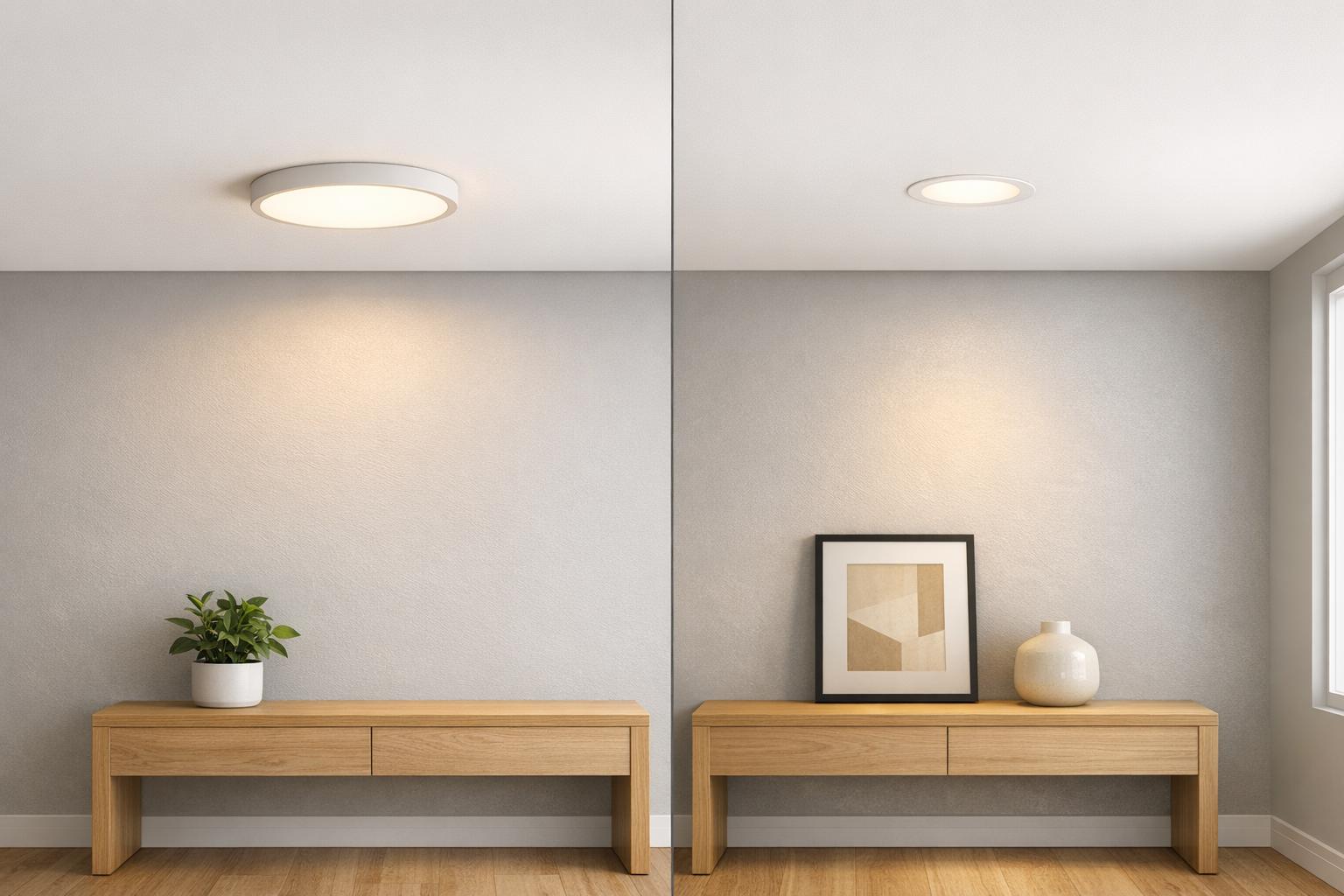
When deciding between surface-mounted and recessed lighting, the choice boils down to installation, design, and budget. Surface-mounted fixtures are installed directly onto ceilings or walls, making them easier and cheaper to install and maintain. They’re ideal for retrofits, solid ceilings, and spaces where quick installation is needed. However, they’re more visible and may not suit modern, sleek interiors.
Recessed fixtures, on the other hand, are installed within ceiling cavities, offering a clean, flush look that’s perfect for low ceilings and contemporary designs. They require more time, skill, and cost to install, often needing structural modifications. While they create a polished aesthetic, they also demand more fixtures to achieve even lighting, increasing overall costs.
| Factor | Surface Mounting | Recessed Mounting |
|---|---|---|
| Installation Time | 30–60 minutes | 2–4+ hours |
| Cost (Per Unit) | $80–$250 | $380–$529 |
| Tools Needed | Basic (drill, screwdriver) | Advanced (saws, templates) |
| Design | Fixture visible | Flush, concealed |
| Maintenance | Easy, fully exposed | Difficult, within ceiling cavity |
| Best Use | Retrofits, industrial spaces | Modern interiors, low ceilings |
For retrofits and tight budgets, surface-mounted lighting is practical and efficient. For new construction or sleek aesthetics, recessed lighting offers a polished finish but at a higher cost. Choose based on your project’s specific needs, ceiling type, and design goals.
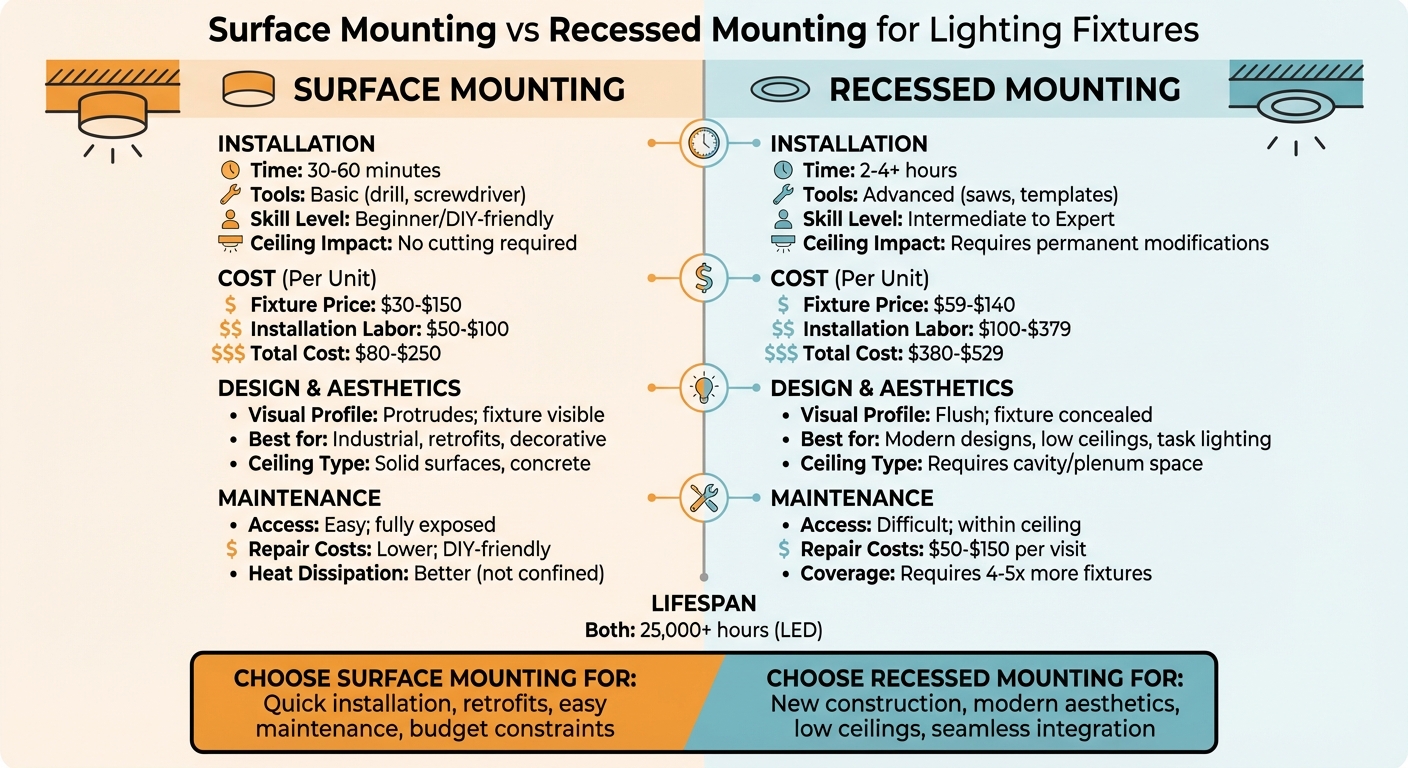
Surface vs Recessed Lighting: Complete Comparison Guide
Surface mounting involves attaching a fixture directly to a ceiling or wall, leaving the entire unit visible. This straightforward "plug and play" method is particularly useful in spaces with solid concrete ceilings, limited plenum depth, or exposed structural elements. It's also a great option for retrofits that rely on existing junction boxes. These features make it a practical choice for many applications.
One of the standout advantages of surface mounting is its simplicity. Installation typically takes just 30–60 minutes with basic tools, compared to the 2–4 hours often required for recessed fixtures.
"If you're aiming for something quick, fuss-free, and budget-friendly, surface mounts are a no-brainer." – Sooraj T. Mathews, Content Creator at Rensup
Maintenance is another plus. With the fixture exposed, tasks like changing bulbs, repairing drivers, or cleaning are much easier - there’s no need to remove ceiling panels. Additionally, surface-mounted fixtures allow for better heat dissipation since they aren't confined to tight ceiling spaces. This can help extend the lifespan of LED components. Despite these advantages, some design considerations may limit their appeal.
The most obvious downside is visibility. Since the fixture is exposed, it might not blend well with modern, minimalist interiors and can make low ceilings feel even lower.
Another issue is lighting quality. Surface-mounted fixtures often create more direct light and stronger shadows, which might not suit projects that call for softer, indirect lighting. If there’s no pre-existing wiring behind the surface, visible conduits or channels may be needed to connect the fixture, which can detract from the overall aesthetic. Finally, because these fixtures extend outward, they’re more susceptible to accidental bumps compared to flush-mounted options.
Recessed mounting involves installing fixtures into a cavity within the ceiling or wall, leaving only the trim visible. This design creates a sleek, subtle look that integrates effortlessly with the surrounding architecture. The typical components of recessed lights include the housing (often called the "can"), trim, reflector, and socket. Recently, canless LED options have gained popularity. These use spring clips to attach directly to drywall, needing just 2 inches of ceiling clearance and eliminating the bulk of traditional housings. This minimalist approach not only enhances the visual appeal but also highlights the practical advantages of recessed lighting.
The main draw of recessed mounting is its ability to deliver a clean and modern aesthetic. These fixtures make spaces appear larger and more open, which is particularly useful in areas with low ceilings where traditional fixtures might feel intrusive. Interior design expert Coral Nafie highlights this benefit:
"Recessed lighting lends a clean, streamlined look to a room. It can increase the light in a room, highlight artwork or other special features, or open up spaces so they look and feel bigger."
Recessed lighting also offers flexibility. Specialized trims - such as eyeball, gimbal, and wall-wash designs - allow for targeted illumination, perfect for showcasing artwork or architectural elements. Many modern recessed lighting systems support advanced features like dimming, color tuning, and integration with smart home controls. For safety and practicality, IC-rated housings enable direct contact with insulation without increasing fire risk, and wet-location trims make these lights suitable for outdoor or moisture-prone areas.
While recessed mounting has clear advantages, it does come with challenges. Installation is complex, often requiring sufficient ceiling depth, accurate hole cutting, and sometimes even removing drywall for proper wiring. These factors contribute to higher costs, with each recessed fixture running between $180 and $480.
As noted by Suntech LED:
"If recessed mount lighting is attempted later [during a retrofit], it will be costly, time consuming and tiring."
Another drawback is the number of fixtures needed. Achieving uniform lighting often requires four to five times as many recessed lights compared to other methods. Once installed, these fixtures are difficult to reposition; removing them leaves large holes that typically require professional repair. Electrical codes also prohibit simply covering wire junctions with drywall, adding to the complexity. Maintenance can be another hurdle, as accessing components like LED drivers often means working within the ceiling cavity, which can be both inconvenient and labor-intensive.
When you break it down, surface and recessed mounting methods differ in several important ways. Let’s take a closer look.
Installation time is one of the most obvious differences. Surface-mounted fixtures are quick and straightforward, taking only 30 to 60 minutes to install. On the other hand, recessed fixtures can take anywhere from 2 to 4 hours - or even longer - per unit. This time difference directly impacts labor costs and project schedules. As Sooraj T. Mathews from Rensup explains, surface mounting is essentially a plug-and-play solution.
Skill level is another key factor. Surface mounting is beginner-friendly and only requires basic tools like a drill and screwdriver. In contrast, recessed mounting is more complex, requiring intermediate to advanced skills along with specialized tools such as drywall saws, hole cutters, and measuring templates. Because of this complexity, recessed installations typically call for professional electricians.
Structural considerations also set these methods apart. Surface-mounted fixtures sit on top of the ceiling or wall, making them a great choice for solid surfaces like concrete or for retrofit projects where cutting into the structure isn’t an option. Recessed fixtures, however, need a cavity or plenum space behind the mounting surface to house the fixture body. As Sally Liu from ZGSM Lighting points out, "Surface mounting is the easiest and most cost-effective way to install luminaires".
These differences can play a big role in deciding which option is best for your project. To make things even clearer, here’s a quick comparison table summarizing the key points.
| Factor | Surface Mounting | Recessed Mounting |
|---|---|---|
| Installation Time | 30–60 minutes | 2–4+ hours |
| Tools Required | Basic (drill, screwdriver) | Advanced (saws, templates) |
| Skill Level | Beginner/DIY-friendly | Intermediate to Expert |
| Ceiling Impact | No cutting required | Requires permanent modifications |
| Structural Needs | Flat surface only | Needs cavity/plenum space |
| Retrofit Ease | High; ideal for existing spaces | Low; costly to retrofit |
| Visual Profile | Protrudes; fixture visible | Flush; fixture concealed |
| Maintenance Access | Easy; full visibility | Difficult; may require disassembly |
| Upfront Cost | Lower; minimal labor | Higher; professional labor required |
| Best Use Case | Industrial, retrofits, decorative | Modern designs, low ceilings, task lighting |
Surface mounting is a straightforward, plug-and-play method that requires only basic tools. You attach the fixture to any flat surface, making it ideal for solid concrete ceilings, exposed structural surfaces, or situations where cutting into the building isn’t feasible. On the other hand, recessed mounting demands more planning due to its structural needs.
For recessed fixtures, timing is everything. As Coral Nafie, an interior design expert at The Spruce, points out:
"The best time to install recessed light fixtures is during initial construction or a major remodeling job when there's access to ceiling joists to anchor the light fixture brackets and wiring boxes".
Recessed fixtures also require enough plenum space - adequate ceiling depth for housing, wiring, and heat dissipation. If your building has limited or no cavity space, surface mounting may be the only viable choice. Additionally, recessed installations must account for potential obstructions like joists, beams, pipes, or wiring that could interfere with cutouts. For buildings with insulated ceilings, recessed fixtures need to be IC-rated to prevent fire hazards when in contact with insulation.
When it comes to aesthetics, surface-mounted fixtures provide a wide range of decorative finishes and styles. In contrast, recessed fixtures deliver a minimalist, integrated look. Recessed options also feature specialized trims, such as baffle trims to reduce glare, reflector trims to enhance light output, and gimbal or eyeball trims to direct light where needed. Wall-wash trims are particularly useful for highlighting artwork or vertical surfaces.
Recessed mounting is especially effective in spaces with low ceilings since the fixtures sit flush, preserving vertical space. Surface-mounted fixtures, while versatile, protrude from the ceiling, which can make smaller spaces feel slightly shorter. As AGC Lighting explains:
"Recessed mounting is great for places with lower ceilings or places without enough height to hang the fixtures".
For new construction or major remodels where the ceiling framing is exposed, recessed mounting is a natural choice. Surface mounting, however, is ideal for retrofits, avoiding the need for drywall cutting. If recessed cutouts are already present, it’s best to continue with recessed fixtures to avoid the hassle of patching.
Surface-mounted fixtures spread light evenly in all directions because they aren't confined by a ceiling cavity. On the other hand, recessed fixtures focus light downward through an opening, creating a more directed beam.
When it comes to illuminating a space, recessed lighting often requires 4-5 times more fixtures to achieve the same coverage as surface-mounted options. This can significantly increase total wattage and energy use in larger installations. While both types commonly use LED technology - which consumes about 90% less energy than traditional lighting - the sheer number of recessed fixtures needed can reduce the overall energy efficiency.
Recessed fixtures are ideal for achieving uniform lighting and minimizing shadows, especially when arranged in a grid pattern. In contrast, surface-mounted fixtures are more directional, which can lead to uneven lighting if not positioned carefully. However, surface-mounted lights are easier to maintain and don't require cutting into the ceiling, making them less intrusive during installation. These distinctions also affect how each type influences building efficiency.
One major concern with recessed lighting is insulation. Poor installation can leave gaps in ceiling insulation, allowing heat to escape and increasing HVAC demands, which drives up utility costs. Surface-mounted fixtures avoid this issue entirely, as they sit outside the ceiling and don't interfere with insulation. Additionally, in spaces with high ceilings, surface-mounted fixtures often require fewer units since their light source is closer to the work plane.
The upfront installation costs for lighting fixtures can vary significantly depending on the mounting method. Surface-mounted fixtures typically cost between $80 and $250 per unit installed, while recessed fixtures range from $380 to $529 per unit. The primary driver of this cost difference is labor: installing surface-mounted lights takes about 30–60 minutes per fixture, whereas recessed installations require 2–4+ hours due to the need for ceiling cutting and wiring.
When labor costs are factored in, recessed lighting projects can end up being 30% to 50% more expensive than surface-mounted installations. Retrofitting recessed lights adds even more to the total cost, as ceiling cavities must be created to accommodate the fixtures. This makes it essential to choose the mounting method that aligns with the project's constraints and budget. While recessed lighting may offer a sleek appearance, the cost differences extend beyond installation.
Maintenance is another critical factor influencing the overall cost. Surface-mounted fixtures are installed externally on the ceiling, making them easy to access for tasks like bulb changes or driver replacements - no special tools are required. On the other hand, recessed fixtures are housed within the ceiling cavity, which complicates repairs. Fixing issues like flickering lights or loose trims often requires a professional electrician, with repair costs ranging from $50 to $150 per visit.
"Surface mounted LEDs are the go-to for cost-effective installations, while recessed lights offer luxury aesthetics." – Emily Carter, Senior Lighting Designer
Both surface-mounted and recessed LED fixtures boast lifespans exceeding 25,000 hours. However, when considering total ownership costs, surface-mounted fixtures are generally more economical, especially in commercial settings. They benefit from lower installation costs, easier maintenance, and the ability to achieve sufficient lighting with fewer units.
| Cost Component | Surface Mounted | Recessed Mounted |
|---|---|---|
| Fixture Price (per unit) | $30 – $150 | $59 – $140 |
| Installation Labor (per unit) | $50 – $100 | $100 – $379 |
| Total Cost (per unit) | $80 – $250 | $380 – $529 |
| Installation Time | 30–60 minutes | 2–4+ hours |
| Maintenance Access | Easy; fully exposed | Difficult; within ceiling |
| Repair Costs | Lower; DIY-friendly | $50 – $150 per visit |
| Expected Lifespan (LED) | 25,000+ hours | 25,000+ hours |
When deciding between surface and recessed mounting, ceiling height and design goals play a big role. Surface mounting is a go-to option for retrofits and spaces with solid concrete ceilings. It's commonly used in industrial settings, warehouses, and underground garages because it’s straightforward to install on existing structures and allows for easy maintenance. In areas with exposed ceilings or limited plenum space, surface mounting becomes the practical solution. Its simplicity stands in contrast to the more involved process of recessed installations.
Recessed mounting, on the other hand, shines in new construction projects. When ceiling joists are accessible, recessed fixtures can be installed with precision before the finishing work begins. This method is often chosen for sleek, modern spaces like upscale offices, galleries, retail stores, and hospitality venues. It’s also the standard for gas station canopies, meeting specific regulations while delivering a polished appearance.
"For locations with low ceilings or insufficient height to suspend fixtures, flush mounting is most appropriate." – LogosLED
Ceiling height is a critical factor. Recessed lighting is ideal for low ceilings, keeping the fixtures flush and unobtrusive. In spaces with very high ceilings, surface or suspended mounting works better, bringing the light closer to the work area. For instance, schools might combine recessed lighting in classrooms for general illumination with surface-mounted fixtures as decorative accents in communal areas. Similarly, recessed, moisture-rated fixtures are often the choice for municipal bathrooms and other damp environments. This balance highlights how spatial design influences the decision between these mounting methods.
It’s also worth noting that recessed systems can require 4–5 times more fixtures. For retrofits, surface mounting is a cost-effective option, reducing labor and eliminating the need to rewire finished ceilings. When lighting fixtures are meant to double as decorative elements, surface mounting often becomes the preferred choice.

In Texas, selecting the right lighting installation method depends on factors like ceiling type, project stage, and long-term design objectives. For spaces with solid concrete ceilings, surface mounting is often the go-to choice. Why? Because drilling into concrete for recessed fixtures can be both expensive and complicated. For retrofit projects in schools, government buildings, or commercial spaces, surface mounting offers a practical solution. It eliminates the need for cutting into ceilings or tackling complex rewiring, which helps save both time and money.
On the flip side, new construction projects open up more possibilities. When plenum space and wiring are incorporated into the initial design, recessed mounting becomes an attractive option. This approach creates a clean, modern aesthetic, perfect for high-end offices or public-facing facilities. However, it’s critical to use Type IC-rated fixtures to comply with state codes. These fixtures are designed for direct contact with insulation, or they must maintain a 3-inch clearance from the enclosure and ballast. For spaces with low ceilings, recessed fixtures help preserve headroom, while surface-mounted units excel in high-ceiling areas by providing broad, evenly distributed light. Thoughtful early planning allows for a mix of both recessed and surface-mounted lighting to suit different needs.
Combining these installation techniques can lead to a well-balanced lighting design. For instance, recessed lighting is ideal for general ambient illumination in classrooms or office spaces, while surface-mounted fixtures can serve specific tasks or add decorative flair in areas like lobbies or communal spaces. In outdoor or semi-exposed areas - think gas station canopies or coastal facilities - fixtures labeled "SUITABLE FOR WET LOCATIONS" are essential to handle moisture and environmental challenges.
If you're working with retrofits or solid-concrete ceilings, surface mounting is an excellent choice for its quick, budget-friendly installation and straightforward maintenance. On the other hand, recessed mounting is ideal for new constructions where ceiling cavities are part of the design, delivering a sleek, modern look - though it typically requires more fixtures and higher installation costs. Choosing the right method can make a big difference in achieving effective lighting.
When deciding, consider factors like performance, budget, and the building's design. Often, a combination of both methods strikes the right balance between functionality and aesthetics, making it a popular approach for many successful projects.
If you're planning for commercial, educational, or municipal spaces, consulting a lighting expert is crucial. They can help evaluate photometric needs, ceiling compatibility, and code compliance. For projects in Texas, Texas Lighting Consultants provides tailored, turnkey solutions designed to fit your structure, budget, and long-term goals. Visit texaslightingconsultants.com for more information.
Your choice of mounting method lays the groundwork for lighting that not only performs but also enhances the look and feel of your space for years to come. The decision you make today will shape the lasting success of your lighting design.
Recessed lighting tends to come with a higher price tag compared to surface-mounted fixtures, primarily due to the complexity of its installation. On average, installing recessed lighting costs between $375 and $523 per light, which includes both the fixture and labor. This added expense often stems from the need to cut into ceilings and possibly adjust wiring or electrical systems. The fixtures themselves typically range from $59 to $140, with labor costs contributing a similar amount.
On the other hand, surface-mounted fixtures are much simpler and quicker to install. They don't require any ceiling modifications, which significantly reduces labor costs. This makes them a more budget-friendly choice, particularly for retrofits or areas where access is limited. While recessed lighting provides a clean, streamlined appearance, surface-mounted fixtures are often the more economical and practical solution for many spaces.
Ceiling height plays an important role when deciding between surface-mounted and recessed lighting. For spaces with low ceilings, recessed lighting is often the go-to option. These fixtures sit flush with the ceiling, offering a streamlined look that maximizes headroom. Since they are installed within the ceiling itself, they help you avoid clearance issues in tighter spaces while maintaining a minimalist aesthetic.
In contrast, surface-mounted fixtures work well in situations where recessed lighting isn’t an option - like when the ceiling lacks sufficient structural depth or access to wiring is limited. These fixtures are mounted directly onto the ceiling and extend slightly outward. They’re a practical and budget-friendly choice for both low and high ceilings, depending on the room's design and functionality.
Recessed lighting can come with its own set of maintenance hurdles. One common problem is the accumulation of dust and debris inside the fixture. Since these lights are installed within ceilings or walls, they can easily collect dirt, which reduces their brightness over time. Cleaning them isn’t always straightforward either - it often involves removing ceiling tiles or panels to access the fixture.
Another issue arises from improper installation. If recessed lights aren’t installed correctly, they may come into contact with insulation, potentially causing overheating or moisture-related problems. To avoid these risks, regular inspections are crucial for ensuring safety and preventing damage. Because these lights are built into the ceiling, troubleshooting electrical or structural issues can also be more time-intensive compared to surface-mounted options.
While recessed lighting provides a sleek and modern aesthetic, it’s worth noting that maintaining them often demands more effort than other types of fixtures.

We’re a HUB-certified Texas lighting company specializing in surveys, calculations, and installations for government and contractor projects.
© 2025-26 | Texas Lighting Consultants | All Right Reserved.