January 12, 2026
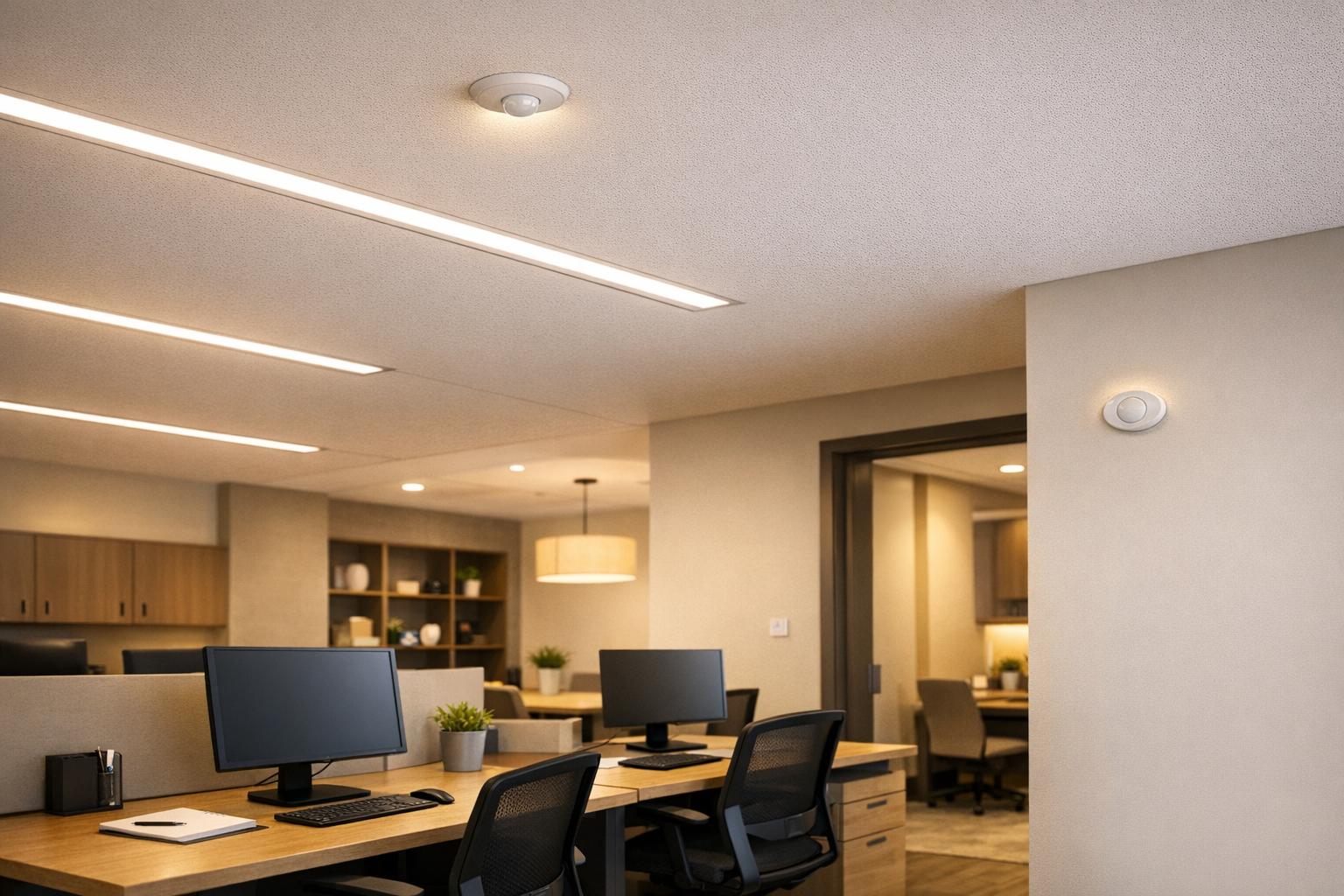
The Texas Energy Code requires occupancy sensors in commercial, educational, and municipal buildings to reduce energy waste. These devices automatically control lighting based on room occupancy, turning lights off within 20 minutes of vacancy. Key points include:
Compliance with these rules saves energy and lowers costs, with projected savings of $1,590 per 1,000 sq. ft. over a building’s lifecycle. While the statewide standard remains the 2015 IECC, some cities have adopted stricter IECC 2021 requirements. Always verify local codes before starting any project.

Texas Energy Code Occupancy Sensor Requirements and Operational Modes
The Texas Energy Code requires occupancy sensors in certain commercial, industrial, and multi-family buildings taller than three stories, as outlined in IECC Section C405.2.1. Below, we’ll break down the specific room requirements and available alternatives detailed in the code.
Certain spaces like educational facilities, offices, and support areas (e.g., copy rooms, lounges, locker rooms) must be equipped with occupancy sensors. Specific rules also apply to warehouses and smaller enclosed spaces:
For open-plan office areas larger than 300 ft², the IECC 2021 mandates control zones no larger than 600 ft². However, local jurisdictions like Austin, Houston, or Dallas may impose stricter standards, so it’s important to confirm local requirements.
An alternative to traditional sensors is Luminaire Level Lighting Controls (LLLC). These advanced systems monitor activity and ambient light at the individual fixture level, offering a compliant and efficient solution for lighting control.
The 2015 IECC-based Texas Energy Code lays out specific technical guidelines designed to save energy without compromising safety. These standards play a vital role in determining how sensors are selected and configured. Here's a closer look at the operational modes required for various spaces.
Different spaces in Texas have distinct requirements for sensor operation modes. Here's how they work:
In commercial spaces, energy efficiency takes precedence, so Manual-ON or Partial-ON sensors are the standard. Full Automatic-ON sensors are restricted to areas like corridors, stairways, restrooms, and lobbies, where safety concerns outweigh energy-saving priorities.
| Sensor Mode | How It Works | Where It's Allowed |
|---|---|---|
| Manual-ON | Occupants manually turn lights on; sensor automatically turns them off | Most commercial spaces |
| Partial-ON | Lights automatically turn on to 50% power; manual activation needed for full brightness | General offices and commercial areas |
| Full Auto-ON | Lights automatically turn on to 100% power upon motion detection | Corridors, stairways, restrooms, and lobbies |
These modes align with the Texas Energy Code to balance energy savings with practical safety considerations.
Proper timeout and sensitivity settings are just as important as the operational modes. According to the code, sensors must turn off lights within 20 minutes of detecting vacancy. While shorter timeout settings are allowed, exceeding this limit is not. During commissioning, it's essential to verify that the timeout complies with this maximum.
Sensitivity settings also play a critical role. Sensors need to identify occupants accurately within their designated area while ignoring irrelevant triggers, such as hallway activity or airflow from HVAC systems. Fine-tuning these settings prevents false activations, which can waste energy and frustrate occupants. In spaces with heavy foot traffic or strong air currents, careful calibration is especially crucial to meet code standards and maintain a comfortable environment.
Not every space in Texas is required to use occupancy sensors. The Texas Energy Code acknowledges that some areas need constant lighting or alternative controls to ensure safety and proper functionality.
Take electrical rooms, for example. These spaces are not allowed to have occupancy sensors, as per the National Electrical Code (NFPA 70). They require continuous lighting for both emergency and maintenance purposes. Similarly, areas that operate with 24-hour lighting are exempt from automatic shutoff requirements.
Emergency pathways, or means of egress, also have specific rules. These areas can use up to 0.2 watts per square foot of continuous lighting to maintain safety during emergencies. Parking garages get exemptions too - transition zones and locations with a total lighting load under 500 watts or a power density below 0.02 W/ft² don’t need to follow the usual dimming or shutoff controls.
Outdoor lighting also has its own set of exceptions. Pole-mounted fixtures up to 75 watts and non-pole-mounted fixtures up to 30 watts aren’t required to have sensors. Additionally, tunnels, building facades, and outdoor dining areas are exempt when continuous lighting is necessary for health or safety reasons.
For spaces that don’t require occupancy sensors, there are alternative control options. According to Section C405.2.1, areas exempt from occupancy sensors must use time-switch controls to manage lighting automatically. It’s also essential to check if your local municipality has adopted stricter amendments that go beyond the state’s baseline requirements. These exemptions aim to strike a balance between energy efficiency and the operational and safety needs of various facilities.
To ensure compliance, start by submitting your lighting plans to your local building department. Inspectors will review your installation to confirm it aligns with the approved plans. If your project involves state-funded or state-owned buildings, you'll also need a compliance statement from a design professional, along with certification from the relevant state agency.
In Texas, COMcheck is the go-to software for proving your lighting controls meet the 2015 IECC or ASHRAE 90.1-2013 standards. This tool generates compliance reports that simplify the approval process with building officials. Before the final inspection, double-check that all sensors are correctly programmed. A Certificate of Occupancy will only be issued after your plans pass review and the physical inspection is successfully completed. Once approved, keeping thorough documentation is key to staying compliant over time.
Store all compliance certificates in your construction files. For state-funded projects, this includes the design professional's certification statement submitted to the appropriate state agency. If you're following ASHRAE 90.1 guidelines, you'll also need commissioning documentation. This should detail equipment specifications, how the system is intended to operate, and the results of functional testing.
Keep these records organized and easily accessible for future audits or inspections. While compliance is verified during construction, having proper documentation on hand can protect you if questions about code compliance arise later. Be sure to check for any additional local record-keeping requirements to ensure your project files are complete.
Starting January 12, 2026, the State Energy Conservation Office (SECO) continues to enforce the 2015 International Energy Conservation Code (IECC) as the statewide standard for commercial, industrial, and residential buildings taller than three stories. However, many municipalities have opted for the stricter IECC 2021, which means local regulations may go beyond the state baseline. Before beginning any lighting control installation, it's essential to check the specific code adopted by your local jurisdiction, as some areas may have more stringent requirements. This contrast between state and local standards plays a key role in the updates outlined in the PY2026 TRM.
The PY2026 Technical Reference Manual (TRM) highlights the distinctions between state and local standards. While the 2015 IECC remains the baseline for the state, jurisdictions following IECC 2021 enforce stricter measures, including maintaining the established vacancy timeout.
For open-plan office spaces, control zones are now capped at 600 square feet, and lighting power must drop by at least 80% when a zone is unoccupied. In warehouse aisleways, lighting power must decrease by at least 50%, and IECC 2021 emphasizes that each aisleway must have independent controls.
The Energy Systems Laboratory at Texas A&M University continues to evaluate new IECC editions and provide guidance to SECO on potential adoption. Until SECO officially updates the statewide code, the 2015 IECC remains the standard. Always refer to your municipality's "City Adoption List" to confirm the applicable requirements for your project. Being aware of these local amendments is crucial to ensuring compliance before moving forward with any installation.
Installing occupancy sensors according to code standards can lead to major savings for facilities in Texas. For example, commercial buildings can expect 30-year life-cycle savings of $1,590 per 1,000 square feet by adhering to model energy codes, with immediate payback potential. Considering the energy demands of buildings in Texas, compliance could result in statewide cost savings of $3.31 billion for commercial buildings between 2010 and 2030. Beyond financial gains, meeting these standards helps local governments, schools, and state agencies lower utility expenses and improve operational efficiency.
"New construction is the most cost-effective phase in the life of a building to establish energy efficiency elements." - State Energy Conservation Office
The financial and operational benefits highlight the importance of working with experts to ensure compliance.

Navigating evolving energy codes requires expertise, and that’s where Texas Lighting Consultants comes in. We assist commercial, educational, and municipal facilities in achieving compliance through professional design, installation, and documentation support. From occupancy sensor installations to full compliance across required spaces, we’ve got you covered.
Our specialty lies in low-voltage control systems designed to meet Manual-ON and Partial-ON requirements, ensuring that lights activate at no more than 50% power in designated areas. This approach not only satisfies code mandates but also enhances long-term savings. As a HUB-certified, woman-owned business, we provide end-to-end solutions, including LED retrofits, rebate assistance, and compliance documentation - making the process seamless for both public and private projects across Texas.
The Texas Energy Code categorizes occupancy sensors based on how they manage lighting activation and whether manual operation is required:
Choosing the right type of sensor depends on the energy code requirements specific to your space. For guidance and proper installation, Texas Lighting Consultants can assist in ensuring compliance while improving energy efficiency.
Local jurisdictions in Texas have the authority to implement stricter rules than those outlined in the Texas Energy Code. This code is based on the 2015 International Energy Conservation Code (IECC) and ASHRAE 90.1-2013. Some cities and counties, for instance, may require occupancy sensors that turn off lights within 20 minutes of vacancy or mandate that lighting power be limited to 50% when first turned on. These local variations can impact the way lighting is designed, installed, and inspected.
To stay on the right side of these regulations, it's crucial for project teams to verify the specific requirements of the city or county where the building is located before finalizing any lighting plans. Texas Lighting Consultants can help simplify this process. They specialize in navigating local and state regulations, providing tailored solutions that align with all codes while also streamlining permitting and inspections. With careful planning, you can avoid unexpected changes and keep the approval process running smoothly.
Occupancy sensors are a smart way to cut down on energy expenses in commercial buildings. By automatically turning off lights and other systems in empty spaces, they help eliminate unnecessary energy use. This means lights are only on when they're actually needed, leading to noticeable reductions in utility bills.
The amount you save depends on factors like the building's size, how spaces are used, and where the sensors are installed. However, research shows that occupancy sensors can lower lighting energy consumption by 25% to 60%. Over time, these savings can easily cover the installation costs and make building operations more energy-efficient and budget-friendly.

We’re a HUB-certified Texas lighting company specializing in surveys, calculations, and installations for government and contractor projects.
© 2025-26 | Texas Lighting Consultants | All Right Reserved.